


One Position Left Standing
Some weeks you lose the battle. This was one of them.
The context was already uncomfortable going in. A market running hot, volatility biting harder than usual on anything with real amplitude in its daily range, and a growing sense that the setups worth taking were getting harder to find at these levels.
We had pulled back. Deliberately.
And on Friday, while we were away from the screens for work, the Nasdaq dropped over four percent in a single session. Its worst single day since April 2025.
The S&P 500 shed 2.6%, snapping a nine-week winning streak, the longest the index had strung together in years. The trigger was not a geopolitical shock or an earnings disaster. A stronger-than-expected jobs report pushed bond yields sharply higher and rekindled fears that the Federal Reserve will be forced to raise interest rates before the year is out.
Markets priced it fast and with no mercy.
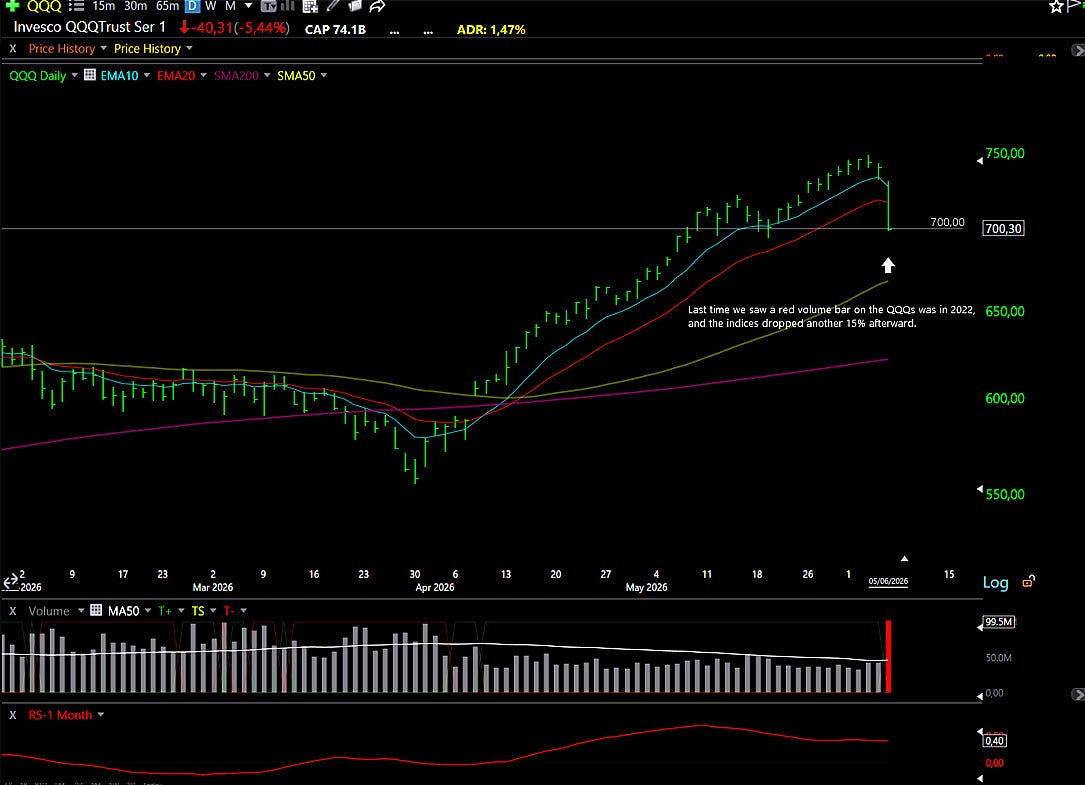
We came back to the portfolio and found what we expected: almost everything gone. The stops we run when we are away from the desk did exactly what they were supposed to do, which is a sentence that sounds straightforward until you actually live through the session that triggers them.
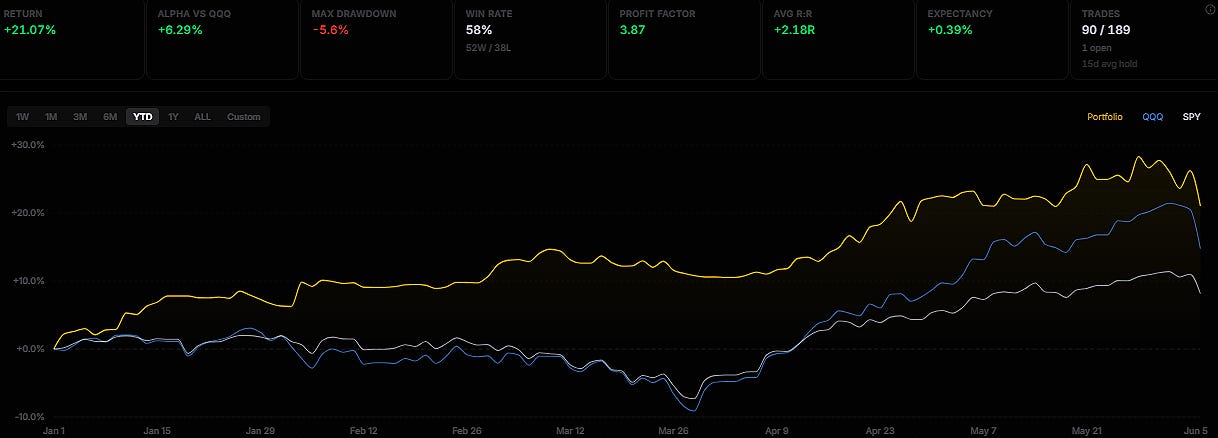
One position had a stop in profit and closed the day significantly lower than where it was taken out. Others were clean losses. None of this felt good. But the math told a different story: relative to the index, we lost less.
Against a Nasdaq down over four percent on the day, that gap in performance matters more than the absolute number.
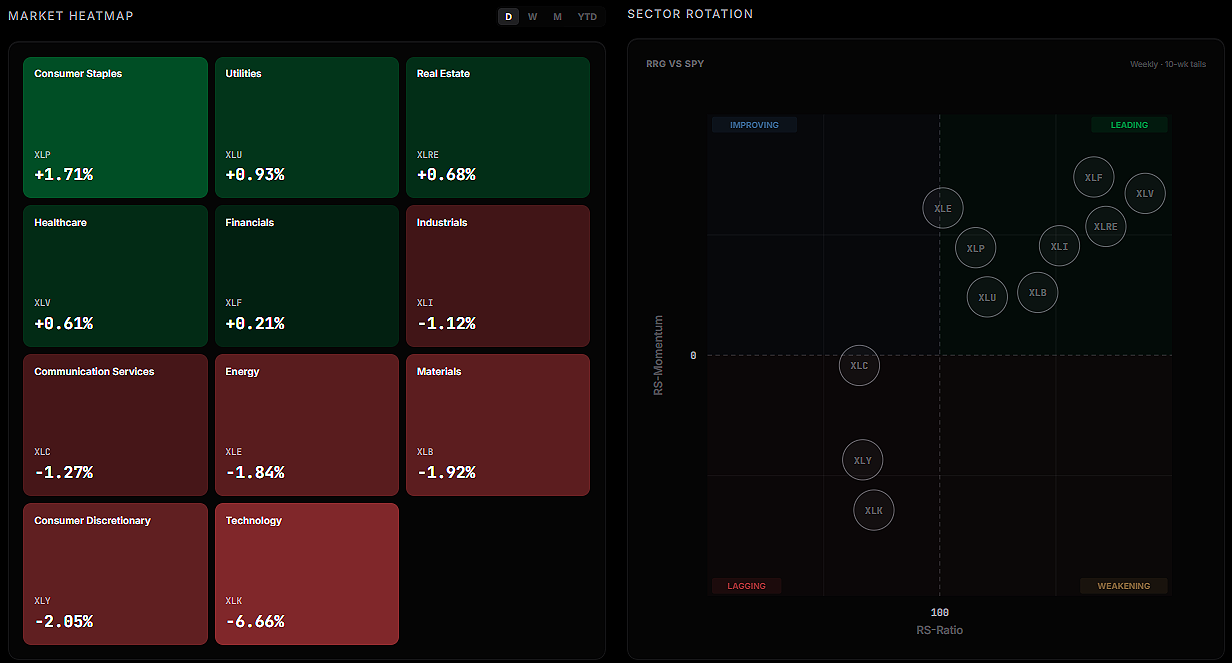
Here is the thing about momentum and growth portfolios that does not get said enough. The sell-off on Friday was not uniform. Healthcare and Staples held up while tech was being dismantled. Colgate-Palmolive (CL) added four percent. Coca-Cola gained three (KO). Johnson and Johnson (JNJ) was up two.
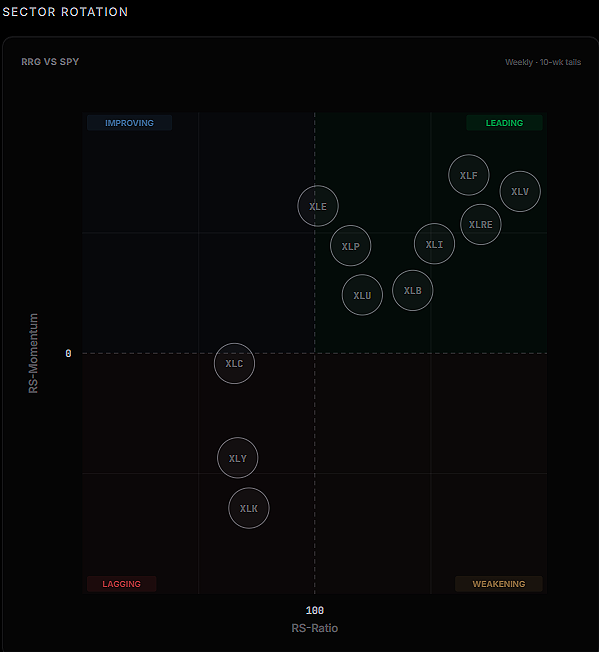
An aggressive growth portfolio with concentrated tech exposure could have lost fifteen, eighteen, or twenty percent in a single session without anyone exaggerating. That kind of day does not feel theoretical when you are watching it happen in real time.
The weeks before Friday, when we were slowing down and second-guessing ourselves, when our style felt slightly out of sync with a market that kept locking up and grinding higher in ways that made our entries awkward, it turns out that discomfort was doing work. The discipline to reduce exposure when things do not feel right is easy to undervalue in a bull market.
It pays in moments like this one.
There is one thing that prevents this from being a completely dark read.
Not everything went down together on Friday. We have identified at least two or three industries that spent the session consolidating rather than collapsing. A handful of names on the watchlist closed the day positive or flat while tech was being sold aggressively. Whether that resilience reflects genuine capital rotation or simply a delay before the same selling pressure arrives, we do not know yet. The next few sessions will answer that question.
Our single surviving position is holding its ground. We are watching it closely.
Fasten your seatbelts. This is where things get interesting
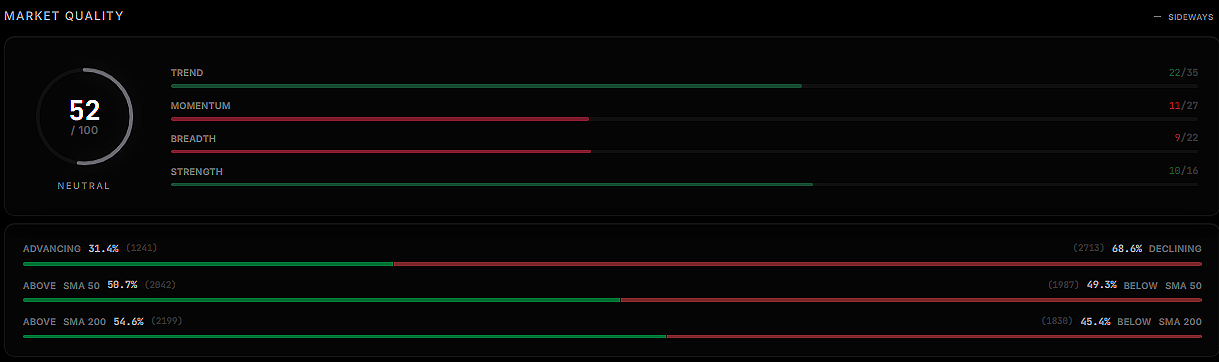
Here’s a look at this week’s market health, with a breakdown of index and sector performance.

We’re currently building the beta version of our app, and it’s already live.
It is not a generic solution for every market participant, but a platform built specifically for swing trading, momentum strategies, and short to medium-term investing.
You can already sign up, access the beta, and start using it today.
As previously stated, all paid subscribers will receive full access to the platform at no additional cost.

Latest articles:


Each stock carries a risk badge: ⚠️ High | 📊 Medium | 🛡️ Low.
Based on volatility, float, technicals, and fundamentals. Size your positions accordingly.
📈 Free Setup: Make It Count
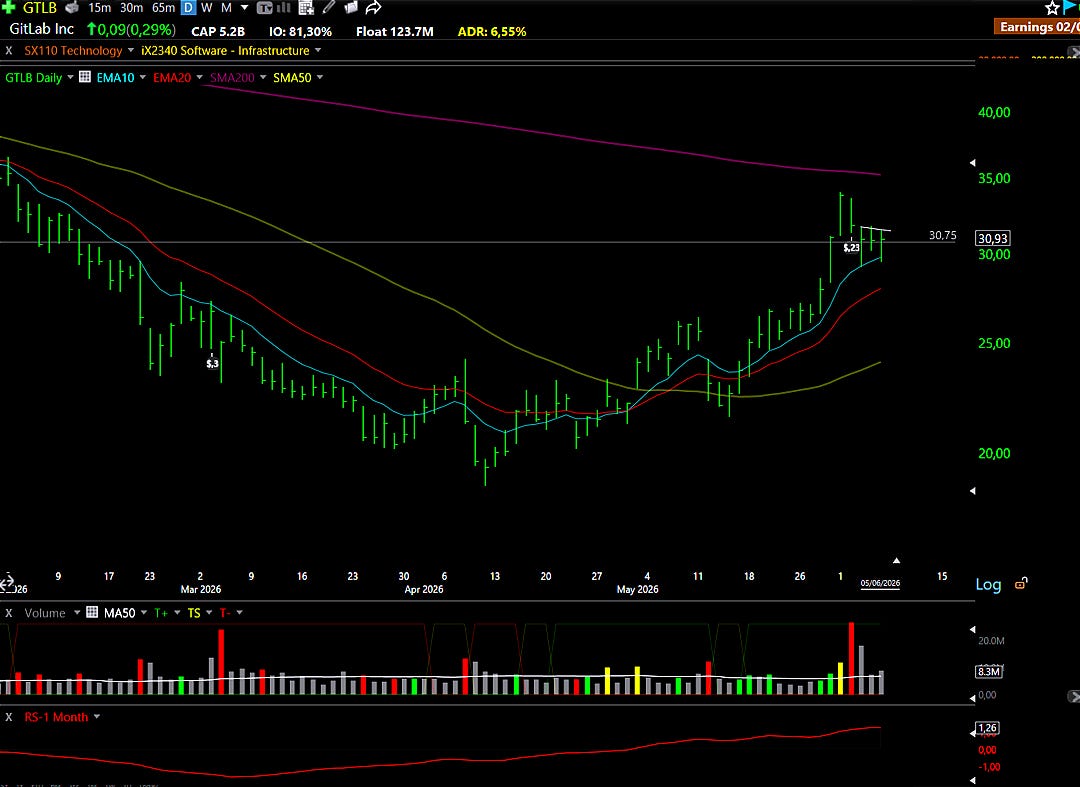
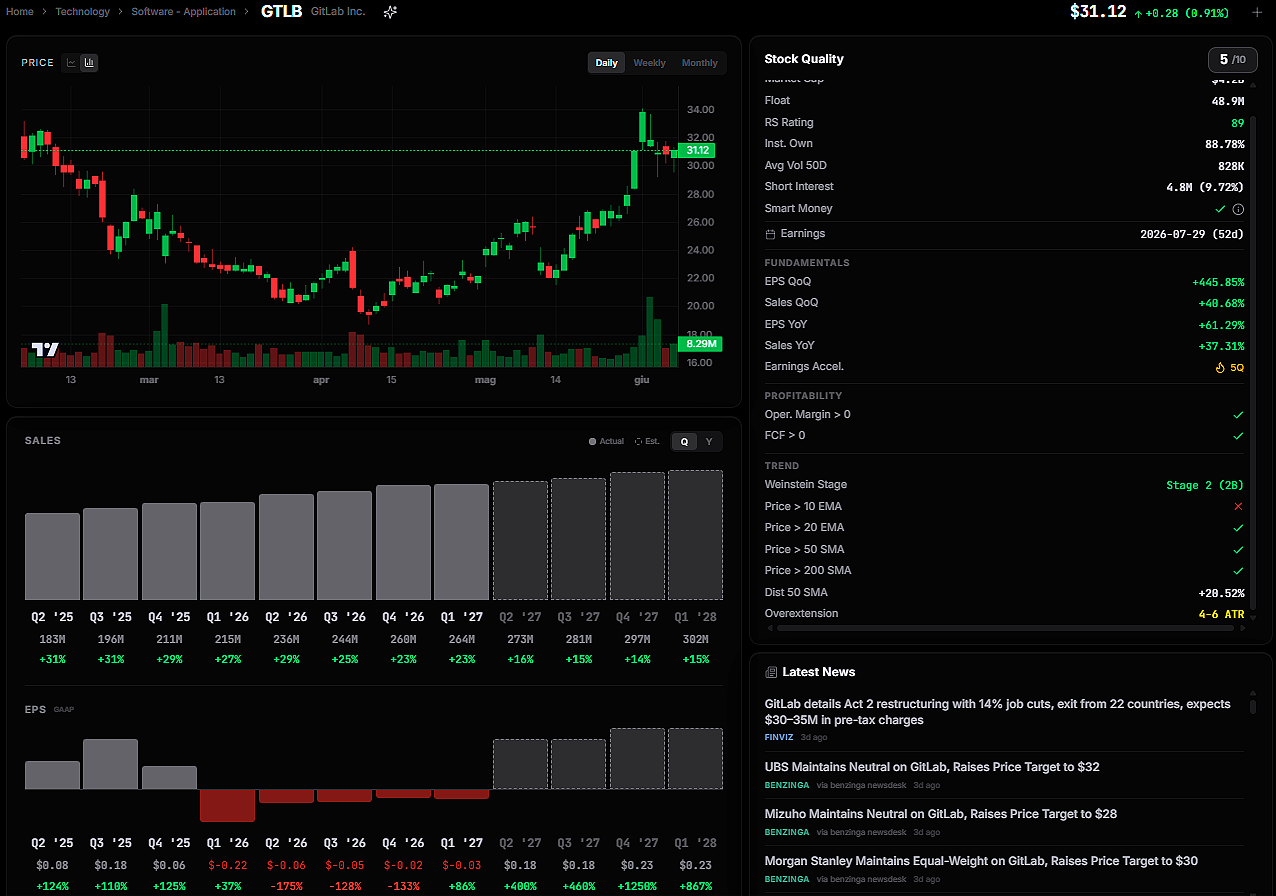
GTLB: GitLab Inc 📊
What they do: A software platform that manages the entire development lifecycle
Why watch? GitLab operates in a space that sounds mundane until you understand what is actually happening inside it. DevOps platforms are the infrastructure layer through which every line of enterprise software gets written, reviewed, tested, and shipped. When that layer starts absorbing AI and agentic workflows, usage data accelerates in ways that simple seat-count metrics miss entirely.
Q1 revenue grew 23% year over year to $264 million, beating expectations by four percentage points and holding exactly flat with the prior quarter’s growth pace. For a company that had previously signaled macro headwinds, maintaining that rate rather than decelerating was the move no one expected. The CEO’s commentary on the call was more interesting than the headline. Code pushes across the paid SaaS customer base are up 49% year over year. CI pipeline growth, which measures how frequently customers are running automated build and test processes, accelerated from the mid-twenties in late 2025 to 38% in April. One of GitLab’s most advanced agentic customers grew the total volume of code in their repositories by two and a half times in six months, and the growth is still accelerating. These metrics measure actual usage intensity, and they are going up fast.
The company also introduced GitLab Flex, a program allowing customers to purchase both traditional seats and usage credits in combination. Consumption-based models tend to expand revenue naturally as usage grows, without requiring a separate sales conversation every time a customer does more. It removes friction from the monetization path at exactly the moment when usage is accelerating.
Technical Outlook: The price action on Friday was the detail worth noting. With the Nasdaq collapsing over four percent, GitLab closed flat. That kind of relative strength in a session like that one is not accidental. The stock tested the 10-day EMA for the second time this week and held both times, closing the day green after recovering early losses. The consolidation is young, only a couple of sessions deep, so ideally we see more before committing. But this goes on the must-watch list, and Friday’s behavior is exactly the kind of signal we pay attention to when the broader market is doing its worst.

Why We Don’t Wait for Sunday
Markets don’t move on your schedule. The best low-risk entries don’t announce themselves politely and wait for the weekend newsletter.
They show up when they show up. And if you’re not positioned, you miss them.
Paid members get real-time alerts: exact entries, stops, position sizing, and the thesis behind every trade. The same information we use to manage our own capital.
Free members get just one pick on Sunday.
Does that sound like an edge to you?
What’s Inside Premium
Free Access to TradeDeck
Premium members get early access to TradeDeck, the trading platform we’re building. The value of the platform alone already exceeds the cost of the subscription.
Watchlist Elite (5-7 Stocks)
Each selection undergoes rigorous financial analysis, technical evaluation, and strategic assessment.
Full Portfolio Transparency
Every position we hold. Entry price. Current P&L. Stop level. Real money, real risk.
Real-Time Trade Alerts (Chat Access)
This is where the edge lives. Exact entries, stops, and position sizing. Real-time. No lag
Quick Picks (5 Names)
Additional setups that just missed our main criteria but are worth watching.
Chat Access
See our thought process in real time. Ask questions. Watch how we manage risk.
The Tools We Actually Use
Member discounts on TC2000, Fiscal.ai, and other platforms. Same tools, better pricing.
What Paid Members Say:
We’re entrepreneurs first, traders second. We’ve sat in the CEO chair. We know what real execution looks like and how to spot it.
€39/month or 299€/year. Less than one losing trade. Cancel anytime.
Portfolio updates and new positions:


💎📈 Watchlist Elite: Premium Market Movers
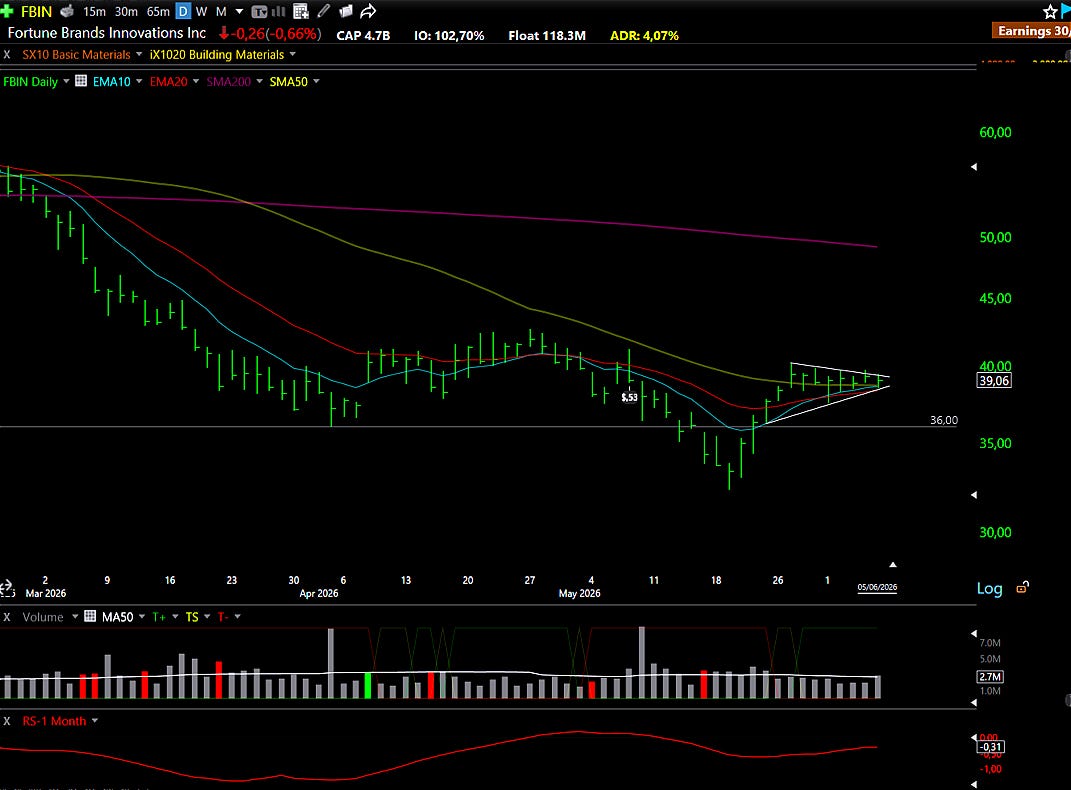
FBIN: Fortune Brands Innovations Inc 📊
What they do: A home products company selling plumbing fixtures, doors, and outdoor products
Why watch? The honest answer is that the fundamental picture here is not clean. Q1 revenue fell 2.1% year over year to roughly a billion dollars. Excluding China, which remained a meaningful drag with sales down 25%, the core business was still down 1.2%. Management cut the full-year sales, margin, and earnings outlook. The narrative shifted from a company temporarily pressured by soft housing demand to a company dealing with soft housing demand and its own internal execution problems at the same time.
That distinction matters, and management deserves credit for not dressing it up.
What keeps this on the watchlist despite all of that is a single data point that is harder to dismiss than any analyst estimate. An insider bought two million dollars worth of stock two or three weeks ago, near the lows. Insiders buy for many reasons, but they only buy when they believe the price is too low.
At that level, with full knowledge of the internal challenges, someone chose to put two million of their own money into the stock. That is a signal worth respecting.
The housing market is structurally soft, and the stock has reflected that since 2022. The question is not whether the business is great. The question is how much of the bad news is already in the price. At the $36 level, the stock is sitting where it last traded in 2019 and briefly during the pandemic crash. That is a long-term monthly reference with a history of acting as a floor.
Technical Outlook: The stock dipped below $36 for only a couple of sessions before recovering, and it is now consolidating above that level with the 10, 20, and 50-day moving averages all stacked together and sitting very close to the current price. When all three moving averages compress like that around a price, it tends to precede a directional move. The first meaningful target if the stock breaks higher is the 200-day moving average near $50. The risk-reward between here and there is the reason this name is on the list.
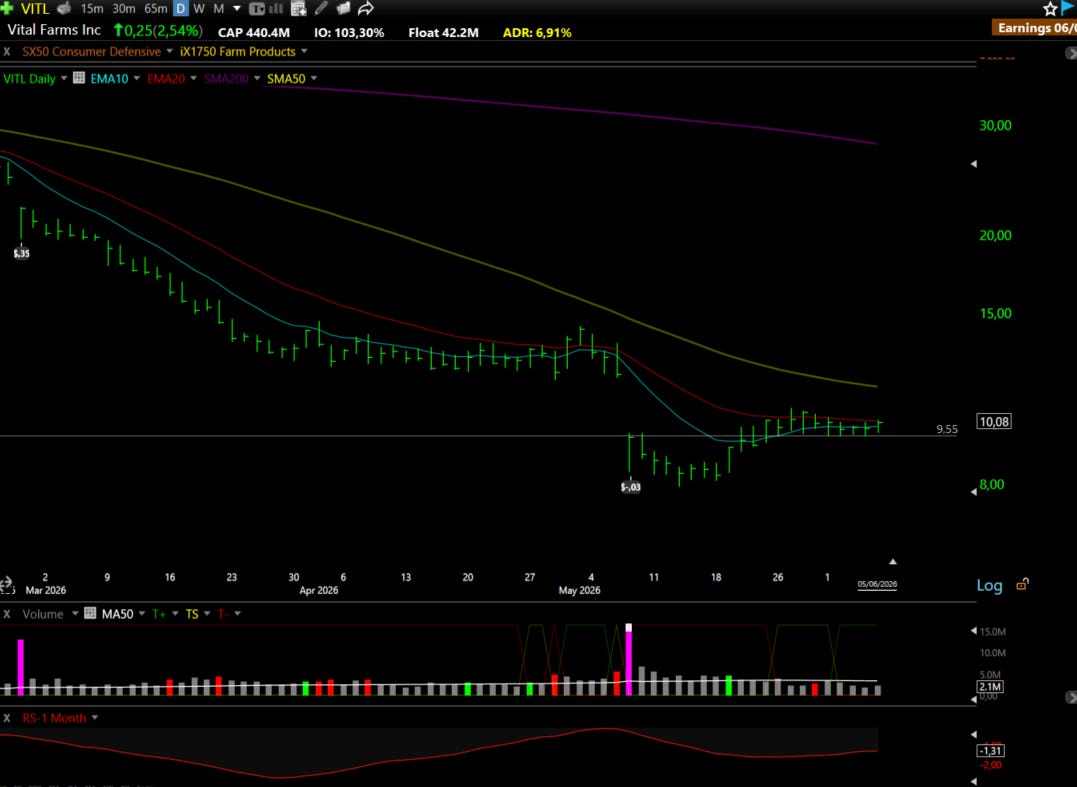
VITL: Vital Farms Inc ⚠️
What they do: A premium pasture-raised egg and butter brand
Why watch? Q1 was genuinely bad. Revenue came in at $187 million, a 15% increase year over year, but nearly fifteen points below what analysts were expecting. The earnings number was worse: the consensus called for a small profit, and the company delivered a loss instead.
The stock has already absorbed most of that damage.
The broader context is worth understanding. The egg market has been through a textbook demand-supply cycle. The bird flu outbreak in 2025 wiped out enough supply to push retail egg prices to a record high of around $8 a dozen. Producers invested heavily to rebuild capacity, and now that capacity has come online all at once. Supply has overshot demand, prices have collapsed to a decade low, and the pressure is hitting revenue and margins across the entire category. This is not a Vital Farms-specific problem. It is a category problem that happens to be hitting the earnings line at the wrong moment.
The reason to stay interested is that premium brands with genuine consumer loyalty historically navigate the trough of these cycles better than commodity operators and recover faster when the pricing environment normalizes. Vital Farms is not selling generic eggs. It has built real brand equity in a segment of the market that trades on values, not just price. We tried this name once before near $12 and were stopped out. At current levels, with the category near the bottom of a pricing cycle and the valuation reset, the risk-reward looks different from what it did.
Technical Outlook: Support has been holding near $9.55 since mid-May, a level that also corresponds to the high of the gap-down session, which is the kind of technical reference the market tends to respect. The real breakout level is above $10.50, though an entry above $10.25 with a stop just below the main support is where the setup becomes actionable. On Friday, with the indices collapsing, Vital Farms closed up two percent. Relative strength like that on a session like Friday is exactly the kind of detail that earns a name a closer look.
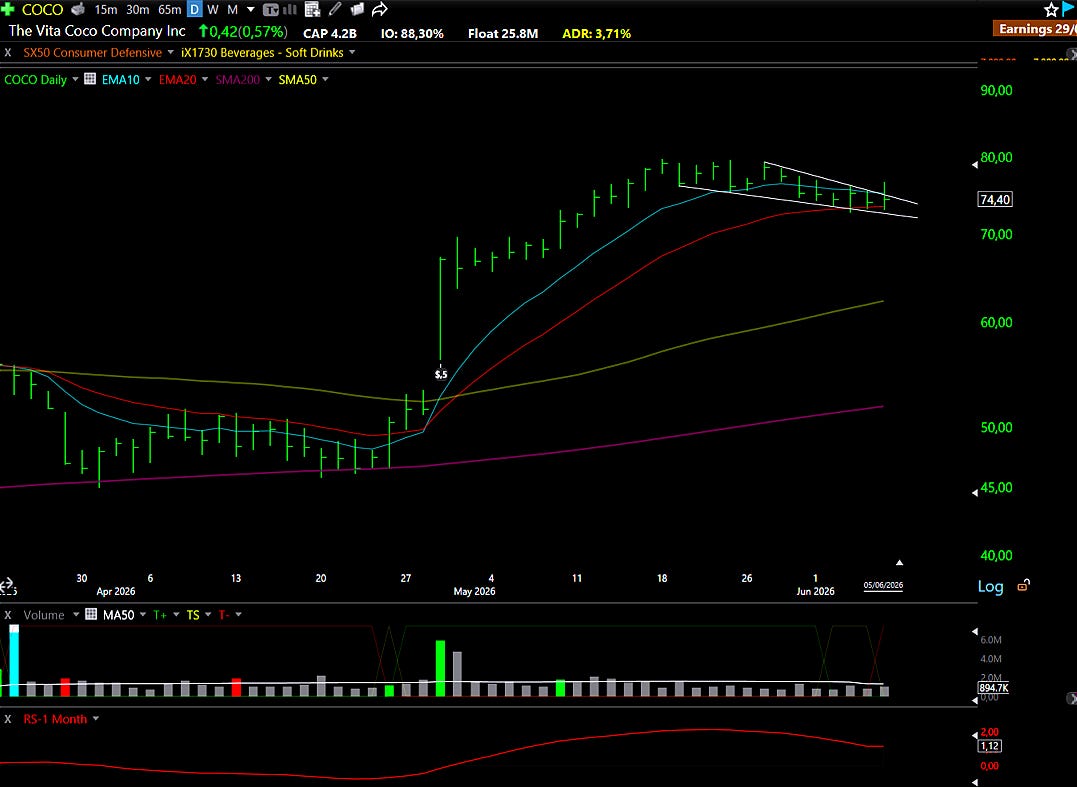
COCO: The Vita Coco Company Inc 🛡️
What they do: A branded coconut water company
Why watch? The Q1 numbers were not just good. They were the kind of quarters that change how you have to think about a business. Net sales grew 37% year over year, driven by both volume and pricing. Total shipment volumes were up 30%, and price-mix contributed an additional 5.4%. Branded Vita Coco Coconut Water sales specifically grew 42%, with branded volumes up 32%. Gross margin expanded to roughly 40%, pushing gross profit from $48 million to $71 million in a single quarter.
The detail that matters most is what the growth was not. It was not promotional loading, where a brand floods distribution channels with discounted products to manufacture a strong quarter that borrows from future demand. The volume growth was real, and the pricing held. More people bought the product, and the people who already bought it bought more. That is the kind of demand signal that changes the earnings growth outlook, not just the narrative.
The stock is not cheap after that quarter, and it should not be. But expensive on old numbers is different from expensive on new ones, and the Q1 results shifted the baseline.
Technical Outlook: After a 40% run following earnings, the stock is now consolidating for the first time, forming a falling wedge near the 10 and 20-day EMAs on declining volume. The stock attempted a breakout on Friday without success but managed to close the day green despite broad market weakness. In an environment where the market may start rotating into more defensive consumer names, this is exactly the kind of brand that tends to attract capital. The setup is developing. We are watching for the wedge to resolve.
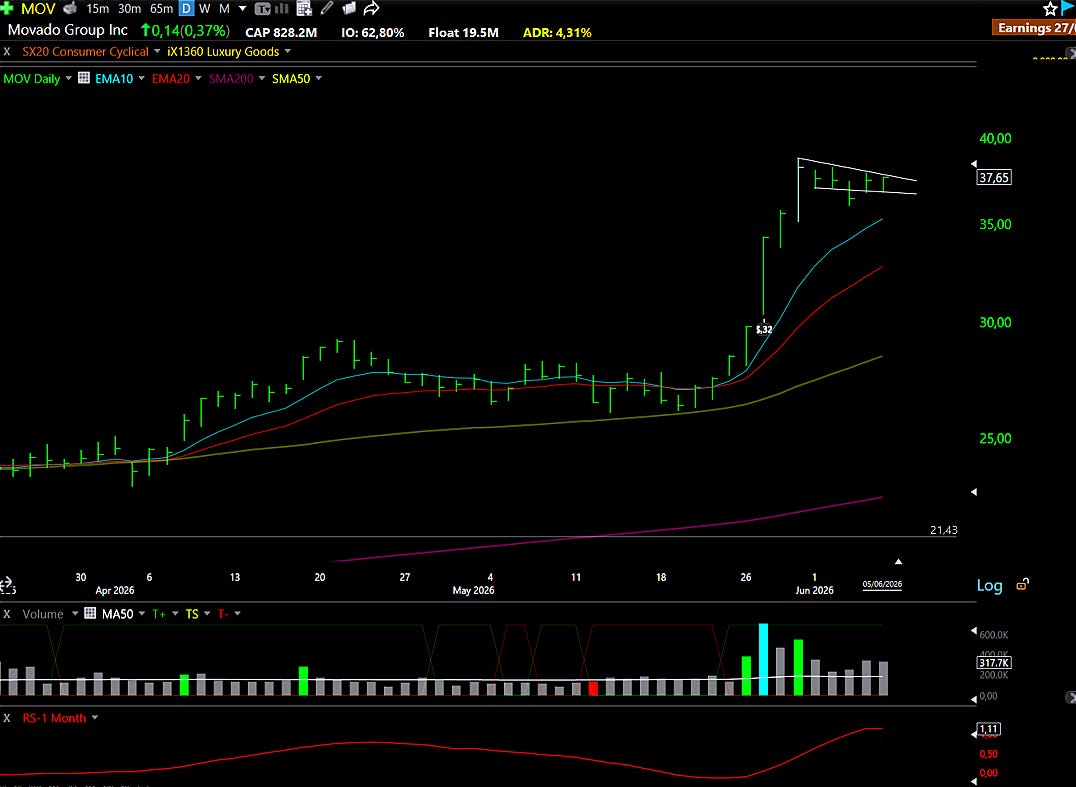
MOV: Movado Group Inc 📊
What they do: A watch manufacturer and retailer, operating the Movado brand alongside licensed brands including Coach, Tommy Hilfiger, and Hugo Boss
Why watch? The Q1 FY2027 results were strong across every line that matters. Revenue beat expectations, driven by a favorable product mix, higher wholesale volumes, and a currency tailwind of roughly $4.7 million. EPS came in at $0.30. Operating cash flow swung positive. EBITDA more than tripled. The stock moved nearly 30% in three sessions after the report.
What makes the balance sheet worth discussing is that it changes the risk profile of the entire investment. The company carries a net cash position consistently above $200 million, which means the business has the financial flexibility to navigate a difficult consumer environment without the pressure that forces weaker-capitalized competitors into destructive decisions. Management chose not to provide formal guidance precisely because of market uncertainty, which is an honest call and a better one than issuing a range they cannot defend. When a company with $200 million in net cash decides to stay cautious rather than promise things they cannot control, that is discipline, not weakness.
Technical Outlook: After the post-earnings surge, the stock is beginning to consolidate. The 10 and 20-day EMAs are still a distance below the current price, which means the ideal scenario is more time rather than an immediate entry. We want the moving averages to catch up to price before the next leg, and a few more sessions of quiet consolidation would build a cleaner setup. The relative strength through Friday’s market weakness is noted. When a stock can hold its gains while the broader market is selling off hard, that is the market telling you something about where capital wants to go.
These tickers below didn’t make the main cut, but they’re on our radar for a reason. We’ve vetted them; now you decide if they fit your game.
More opportunities, less noise.
⚡📋Scanned Stocks: Quick Picks
SPPL - Simpple Ltd
VSXY - Victoria’s Secret & Co
BIRK - Birkenstock Holding plc
SPOT - Spotify Technology
STUB - StubHub Holdings Inc
"Of all speculative blunders there are few greater than trying to average a losing game."
Jesse Livermore
Disclaimer: This analysis is for informational purposes only and should not be considered financial advice. Always conduct your research and consult with a licensed financial advisor before making investment decisions.