


Chasing Strength, Managing Distance
Now and then, life steps in and pulls attention away from the screens.
The past couple of weeks have been one of those stretches for us. Inevitably, that showed up in performance. We’ve lagged the indices while they kept grinding higher, steadily closing the gap on the alpha we had built earlier in 2026.
There’s no point in repeating how frustrating and, at the same time, impressive this rally has been. What matters now is staying in the game long enough to take advantage of what comes next. If and when a pullback starts to take shape, our priority is simple: be positioned to navigate it, not chase what has already happened.
Truth is, not much has changed since two weeks ago. The market structure remains largely the same, and so does our approach. Exposure has been scaled back to a minimum, and cash levels have increased accordingly.

The watchlist reflects that environment.
It’s not particularly rich in actionable setups right now, which is consistent with a market that hasn’t offered meaningful retracements. For our style of trading, a pullback is not just helpful, it’s necessary. That said, there are still a few names worth paying attention to, even if the broader opportunity set remains limited.
In the background, work on TradeDeck continues to move forward.
We’re genuinely excited about how it’s evolving. The launch has been pushed back slightly, mainly because we decided to spend more time refining the visual layer and, more importantly, developing two features that we believe can make a real difference.
The first revolves around thematic baskets and how they develop.
The goal is to better understand where a theme stands within its natural cycle of supply and demand, and to quantify its level of maturity within that process.
The second is an algorithmic engine designed to identify emerging trends and themes before they become widely recognized. It’s an ambitious undertaking, and far from simple to execute, but we believe it can add a level of depth that goes well beyond our initial vision for the platform.
There’s still a lot of work ahead, no question about that. But the direction feels right, and confidence in what we’re building continues to grow.
Here’s a look at this week’s market health, with a breakdown of index and sector performance.


We’re currently building the beta version of our app, and it’s already live.
It is not a generic solution for every market participant, but a platform built specifically for swing trading, momentum strategies, and short to medium-term investing.
You can already sign up, access the beta, and start using it today.
As previously stated, all paid subscribers will receive full access to the platform at no additional cost.

Latest articles:


Each stock carries a risk badge: ⚠️ High | 📊 Medium | 🛡️ Low.
Based on volatility, float, technicals, and fundamentals. Size your positions accordingly.
📈 Free Setup: Make It Count
KLAR: Klarna Group plc 📊
What they do: A licensed digital banking and payments platform
Why watch? Klarna has quietly evolved well beyond the BNPL label that most investors still associate with it. The company is now deeply embedded in the broader payments ecosystem, integrated with Stripe and embedded within Apple Pay, meaning that any consumer with a standard bank card can access Klarna’s checkout experience at any Klarna-enabled merchant. That distribution reach creates a formidable competitive moat that newer entrants simply cannot replicate overnight.
The financial results back up the narrative. Fiscal year 2025 delivered $120+ billion in gross merchandise volume, a 22% increase year over year, alongside revenue of $3+ billion, up 25%. Both figures represent records for the company. What makes these numbers particularly interesting is the efficiency story running underneath them. Klarna reduced its headcount from roughly 6,000 employees in 2022 to approximately 3,000 by the time it went public, largely by replacing customer service and marketing functions with AI. It is a fundamental reshaping of the business model, and the margin implications are still working their way through the income statement.
The market, however, appears to be fixating on near-term accounting headwinds related to credit provisioning rather than the longer-term earnings power the business is building. Credit provisioning is essentially the amount a lender sets aside to cover potential loan losses. Klarna’s provisioning has drawn scrutiny, but analysts who have looked closely argue it is being misread. Combine that with strong loan growth and the AI-driven efficiency gains, and the valuation case becomes more interesting than the current price suggests.
The most compelling signal came in March 2026, when Board Chairman Michael Moritz, a partner who has backed some of the most successful technology companies, purchased shares on the open market for a total cost basis exceeding $50 million. Insiders buy for many reasons, but rarely do they deploy that kind of personal capital without genuine conviction. Earnings are due this week.
Technical Outlook: The chart is about as compressed as it gets. The stock has been trading in a range of roughly $0.50 over the past week on declining volume, which is the kind of coiling action that often precedes a sharp directional move. There is a sense that the stock has been overlooked and underappreciated by the broader market, and the upcoming earnings report could be the catalyst that finally forces a rerating. The setup is tight, the risk is defined, and the potential for a meaningful move in either direction is real. Given the insider buying and the fundamental backdrop, the asymmetry appears to favor the upside.


Why We Don’t Wait for Sunday
Markets don’t move on your schedule. The best low-risk entries don’t announce themselves politely and wait for the weekend newsletter.
They show up when they show up. And if you’re not positioned, you miss them.
Paid members get real-time alerts: exact entries, stops, position sizing, and the thesis behind every trade. The same information we use to manage our own capital.
Free members get just one pick on Sunday.
Does that sound like an edge to you?
What’s Inside Premium
Free Access to TradeDeck
Premium members get early access to TradeDeck, the trading platform we’re building. The value of the platform alone already exceeds the cost of the subscription.
Watchlist Elite (5-7 Stocks)
Each selection undergoes rigorous financial analysis, technical evaluation, and strategic assessment.
Full Portfolio Transparency
Every position we hold. Entry price. Current P&L. Stop level. Real money, real risk.
Real-Time Trade Alerts (Chat Access)
This is where the edge lives. Exact entries, stops, and position sizing. Real-time. No lag
Quick Picks (5 Names)
Additional setups that just missed our main criteria but are worth watching.
Chat Access
See our thought process in real time. Ask questions. Watch how we manage risk.
The Tools We Actually Use
Member discounts on TC2000, Fiscal.ai, and other platforms. Same tools, better pricing.
What Paid Members Say:
We’re entrepreneurs first, traders second. We’ve sat in the CEO chair. We know what real execution looks like and how to spot it.
€39/month or 299€/year. Less than one losing trade. Cancel anytime.
Portfolio updates and new positions:


💎📈 Watchlist Elite: Premium Market Movers
IMSR: Terrestrial Energy Inc ⚠️
What they do: A nuclear energy company developing the Integral Molten Salt Reactor
Why watch? The technology at the heart of Terrestrial Energy deserves a plain-language explanation, because it is genuinely different from what most people picture when they think of nuclear power. A molten salt reactor uses liquid fuel rather than solid fuel rods. The uranium is dissolved directly into a salt mixture that circulates through the reactor core. When the reactor is running, the salt is liquid. When it cools, it solidifies. This means that if something goes wrong, the reactor essentially shuts itself down passively, without requiring pumps, backup power, or human intervention. The physics do the safety work.
Terrestrial Energy’s specific design insight goes one step further. Rather than continuously reprocessing the fuel salt, which would require complex plumbing and create significant regulatory complications, the company builds the entire reactor core as a sealed, self-contained unit. You run it for seven years, then replace the unit entirely. That simplicity has profound implications for both the regulatory approval process and the commercial model, and most analysts covering the stock have not fully appreciated how much that design choice changes the risk profile of the investment.
There is another critical advantage that separates IMSR from most of its nuclear peers. Small modular reactors like OKLO require a specialized fuel called High-Assay Low-Enriched Uranium, or HALEU, which is enriched to higher concentrations than standard reactor fuel and currently faces significant supply chain constraints. The IMSR runs on standard low-enriched uranium, enriched to under 5%, the same fuel that powers the existing global reactor fleet. Multiple suppliers can provide it today. No new enrichment infrastructure is required, and there is no dependency on a single supplier. In a world where energy security has become a genuine national priority, supply chain independence is a meaningful competitive advantage.
The timing could not be more relevant. Every major technology company is confronting the same problem simultaneously: artificial intelligence data centers consume extraordinary amounts of electricity, and they need it now, not in 2030. This week brought additional validation, as Terrestrial Energy announced a partnership with Riot Platforms to develop future data centers co-located with advanced nuclear plants. Riot is one of the multiple energy consumers in the technology sector, and its willingness to partner on nuclear co-location adds a meaningful layer of credibility to the commercial thesis.
The nuclear and energy theme is clearly setting up for a broader run. Similar technical patterns are visible across OKLO and the NUCL, suggesting this is a sector-wide rotation rather than a single-stock story.
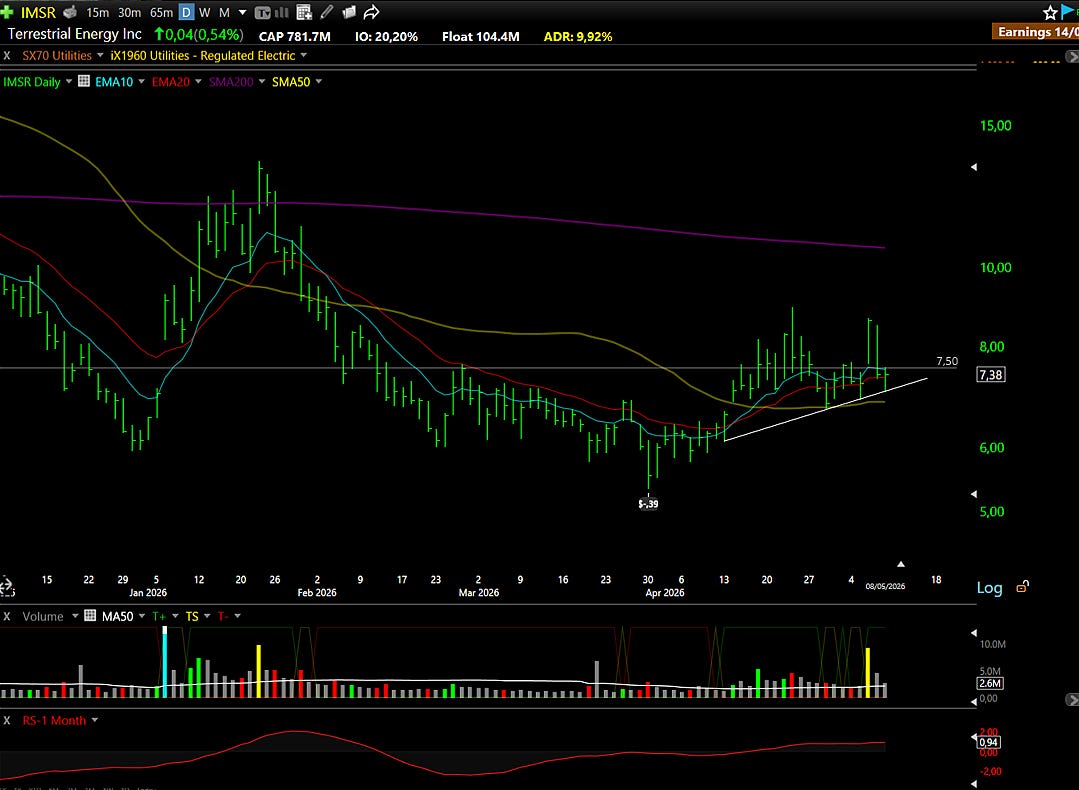
Technical Outlook: The stock fully retraced its move following the Riot news last week, which initially looked discouraging. But Friday’s session told a more interesting story: the stock formed a third consecutive higher low within just two weeks. That pattern of higher lows on a retracement is a classic accumulation signal. Someone is building a position quietly. The key level to watch is $7.50, which represents the line in the sand for the current setup. A clean break above that level on volume would confirm the accumulation thesis. On the downside, a loss of the 50-day simple moving average would invalidate the setup and should serve as the stop-loss reference point.
BLZE: Backblaze Inc ⚠️
What they do: A cloud storage and data protection company
Why watch? Backblaze is undergoing a quiet but meaningful transformation. The company built its reputation as a straightforward, affordable backup storage solution, but the business is now being re-rated by the market as something more strategically valuable: a supplier to neocloud companies, which are the newer generation of cloud providers competing with Amazon, Microsoft, and Google by offering more flexible and cost-effective infrastructure.
The AI connection is direct and growing. Large language models require enormous quantities of data to function, and that data is increasingly multimodal, meaning it spans text, images, audio, and video rather than just structured files. Backblaze provides the storage layer for that data, and the demand signal is becoming impossible to ignore. The company also benefits from the growing need to offer storage alongside compute, with high-performance flash storage emerging as the preferred solution for the most demanding workloads.
The most recent quarterly results made the AI demand story concrete rather than theoretical. Revenue grew 12% year over year to $38.7 million, beating Wall Street’s consensus estimate of $37.8 million by a three-point margin. More importantly, growth accelerated four percentage points compared to the prior quarter’s 8% pace. Revenue acceleration is one of the clearest signals that a business is gaining genuine momentum, and in this case, the acceleration aligns directly with the company’s increasing exposure to AI-driven storage demand. Even after the post-earnings rally, the valuation remains modest relative to the narrative the company is now able to tell.
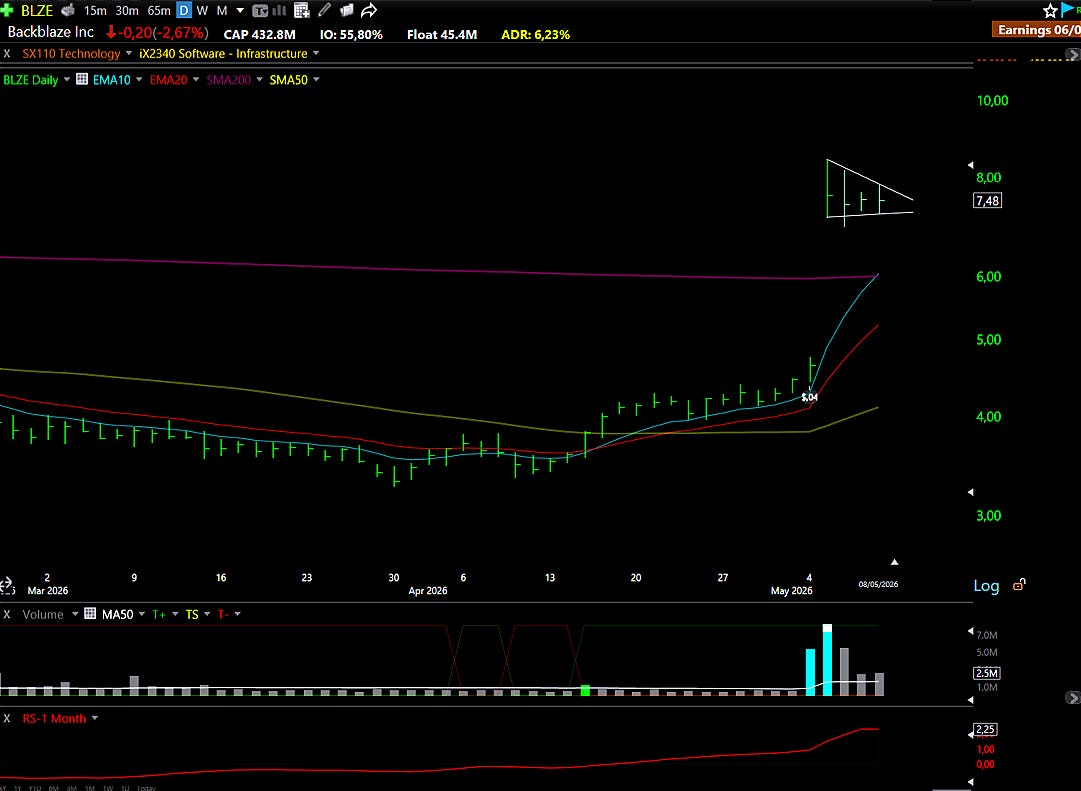
Technical Outlook: The earnings gap produced the highest weekly trading volume since the company’s IPO, and the highest single-day volume in over a year. Volume at that scale is not noise. It reflects institutional conviction, and it changes the character of the stock. The challenge right now is that the move has left the stock extended well above its key exponential moving averages, which means the risk-reward for a new entry is not ideal at current levels. Another week of consolidation would be healthy. The critical support level to watch is $7.00. If the stock holds above that level, the setup becomes immediately actionable. If it drifts below, the stock may need additional time to base before the next leg higher, but the longer-term thesis remains intact.
MRLN: Merlin Inc ⚠️
What they do: A developer of AI-powered autonomous flight software and systems
Why watch? Most investors scanning the AI landscape are focused on software platforms, data center infrastructure, or semiconductor companies. Merlin represents something different: an early-stage company applying AI autonomy to one of the most demanding and consequential environments imaginable: commercial and military aviation.
Founded in 2017 by Matt George, who previously built a mobility company called Burdge, Merlin Labs has developed a product called Merlin Pilot: an integrated hardware and software system that handles the full flight envelope, from takeoff through navigation and air traffic communication to landing. The company went public recently and remains largely under the radar for most institutional investors, which is part of what makes it interesting.
What separates Merlin from the broader field of aviation autonomy startups is where it focuses its technology. The genuine bottlenecks in autonomous flight aren’t the basic mechanics of keeping an aircraft in the air. It’s situational awareness (understanding the full environment around the aircraft in real time) and air traffic control communication (the complex, often ambiguous radio exchanges between pilots and controllers). Merlin Pilot addresses both, including autonomous communication with air traffic control, a capability that most competitors haven’t cracked.
The real-world validation is what elevates this beyond the concept stage. Merlin already holds a $105 million framework contract to integrate autonomous flight technology into the C-130J aircraft used by U.S. Special Operations Forces—one of the most demanding operational environments in military aviation. GE Aerospace has also partnered with Merlin to incorporate AI into GE avionics, with an eye toward the upgrade program for the KC-135 tanker fleet. They represent actual flight hours and real government commitments.
In aviation, the critical barrier isn’t whether the technology works in a controlled setting. It’s whether it can achieve regulatory certification, a process that is notoriously slow, expensive, and unforgiving. Merlin is one of the very few startups actively navigating that certification pathway, which means if they succeed, they won’t just be another AI software company. They could become the foundational autonomy layer for the entire aviation industry, military and commercial alike.
This is an early-stage, high-risk investment. The company is pre-profitability, the regulatory path is long, and execution risk is substantial. But the addressable market, the existing government contracts, and the quality of the partnerships suggest this is a story worth following closely.
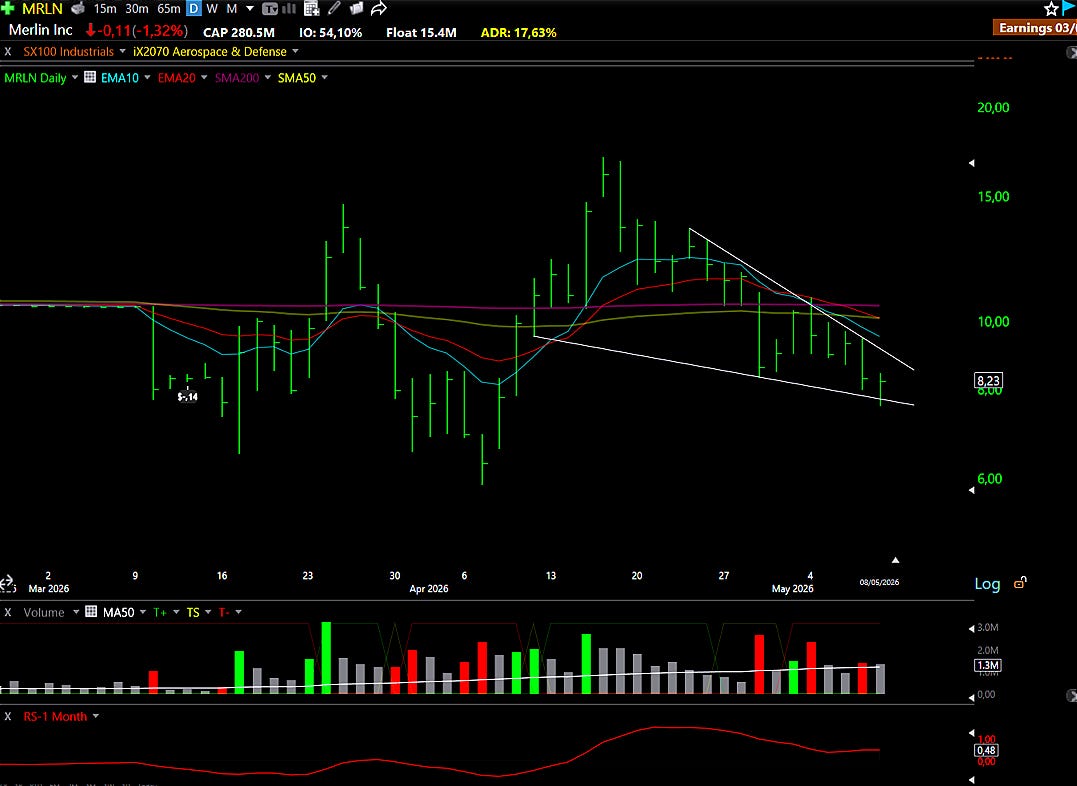
Technical Outlook: The stock is trading below all the major moving averages, which would typically make it an avoid. That said, when it comes to new IPOs, we tend to keep a more open mindset, as moving averages carry less weight given the limited price history.
The 7.90 level clearly stands out as a key support on the daily chart. It has already been tested three times, and each time the price spent very little time below it. That kind of reaction suggests it may act as a meaningful area of demand.
In our view, this could be a reasonable zone to start building a position, with relatively limited risk.
NXT: Nextracker Inc ⚠️
What they do: A provider of intelligent solar tracker systems and software
Why watch? Solar trackers are exactly what they sound like: mechanical systems that allow solar panels to follow the arc of the sun throughout the day rather than remaining fixed in a single position. That seemingly simple adjustment increases energy output by roughly 20 to 30 percent compared to a standard fixed-tilt installation, which has a direct and meaningful impact on the economics of a solar project.
Nextracker has built well beyond the tracker hardware itself. The company’s software platform incorporates AI and machine learning to optimize panel positioning in real time based on weather conditions, shading patterns, and grid demand signals. That software layer creates recurring revenue and deepens customer relationships in ways that pure hardware suppliers cannot match. The company is also expanding into structural and electrical solutions, pre-assembled components, metal frames, and most recently, robotics for automated solar panel cleaning, which addresses one of the persistent operational challenges for large-scale solar installations.
The investment thesis here connects directly to the same theme driving interest in IMSR. The world needs significantly more power, and it needs it soon. AI data centers, electrification of transportation, and industrial decarbonization are all competing for electricity that the current grid cannot reliably supply. Solar, alongside nuclear, is one of the few technologies that can scale quickly enough to meet that demand. Nextracker sits at the intersection of solar infrastructure and AI-enabled optimization, which is a combination that should attract increasing investor attention.
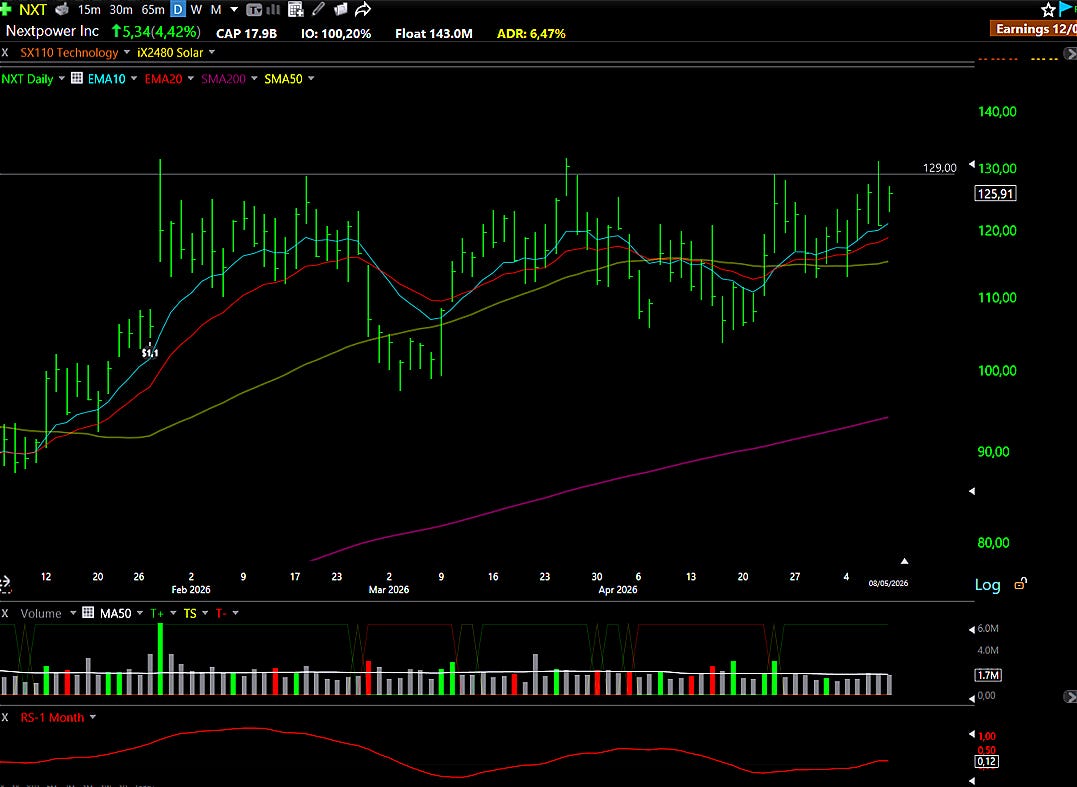
Technical Outlook: The stock has been consolidating since late January, and earnings next week could be the catalyst that finally resolves the pattern. The stock tends to be volatile and requires more room than average, so stop-loss levels need to be set with that in mind. Waiting for the earnings release before establishing a position is the prudent approach here, as the report could either confirm the breakout or reset expectations. The setup is worth monitoring closely, and a clean post-earnings reaction on strong volume would significantly improve the risk-reward profile.
RDCM: Radcom Ltd 📊
What they do: A provider of cloud-native network assurance, observability, and analytics software
Why watch?Radcom occupies a genuinely defensible niche that is easy to overlook but difficult to displace. The company’s core product, RADCOM ACE, is an automated platform that gives telecom operators end-to-end visibility across their entire network, from the radio access layer all the way through to the core. In practical terms, it enables real-time troubleshooting, anomaly detection, and closed-loop analytics at carrier scale. The customers are major communications service providers, the gross margins are high, capital expenditure requirements are minimal, and the balance sheet is clean.
The competitive moat deserves particular attention, especially in an environment where investors are rightly asking which software businesses are vulnerable to AI disruption. Radcom is not selling generic workflow software that an AI model could replicate. The real value the company provides is the ability to acquire, normalize, correlate, and operationalize telecom network data in real time at a scale and complexity that requires deep domain expertise and years of customer integration. The two strongest defenses against AI displacement are proprietary data and deep embedding in customer workflows. Radcom has both, which makes it a more durable business than its modest market capitalization might suggest.
Rather than being threatened by the AI wave, Radcom is actively positioning itself to benefit from it. In February 2026, the company launched Neura, an agentic AI suite built on top of the RADCOM ACE platform. Agentic AI refers to AI systems that can take autonomous actions rather than simply responding to queries. Neura deploys specialized AI agents that work independently across network operations, using the real-time data flowing through RADCOM ACE to improve customer experience, service quality, and network optimization without requiring constant human direction. For a company of Radcom’s size, launching a credible agentic AI product is a meaningful strategic development that most investors following the stock have not yet fully priced in.
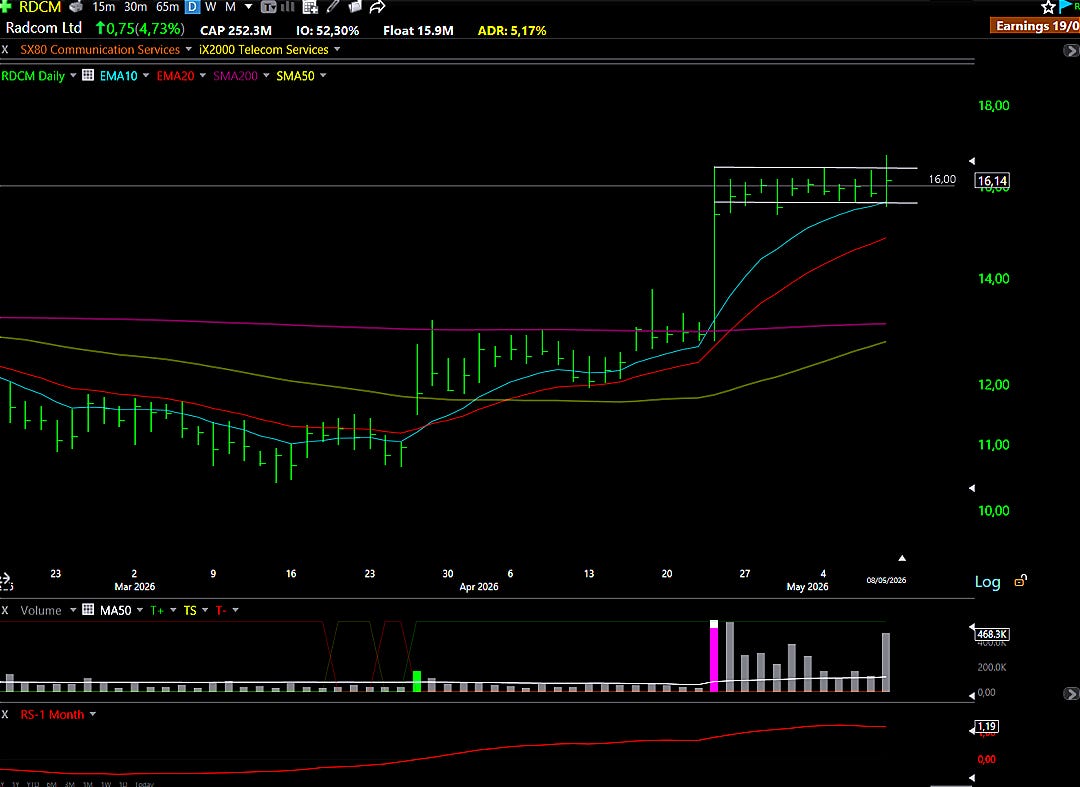
Technical Outlook: The stock is currently trading inside a tight Darvas box, a technical pattern that describes a stock consolidating within a well-defined price range after a prior advance. The range is approximately one dollar wide, which reflects the low liquidity and thin float typical of a company this size. The $16.00 level is the key resistance to clear, as it represents the 2025 highs from roughly a year ago. Beyond that, the next significant resistance sits near $22.00, which is close to all-time highs. Earnings are due in just over a week, so patience is warranted before establishing a full position. A strong report could be the catalyst that finally pushes the stock through the $16.00 ceiling and opens up a much larger move toward the all-time high range.
KSPI: Joint Stock Company Kaspi.kz 🛡️
What they do: A multi-national “super app” based in Kazakhstan that integrates payments, a retail marketplace, and fintech services into a single ecosystem.
Why watch? Kaspi.kz is a fintech powerhouse that dominates the daily lives of consumers in Kazakhstan and is rapidly expanding into markets like Türkiye, Azerbaijan, and Ukraine. Its business model is built on a powerful network effect: as more users join for payments, they naturally migrate to the marketplace and use Kaspi’s lending products, with each segment driving the profitability of the next. Despite its high margins and dominant market share, the stock is currently valued as if it were a low-growth utility rather than a high-growth tech platform.
The expansion into neighboring regions provides a significant “growth option” for investors. With its core Kazakh business generating consistent cash flow, the company has the dry powder to fund its regional ambitions. Furthermore, the improvement in regional commodity cycles and the turnaround of its international holdings like Hepsiburada suggest that the market is severely mispricing Kaspi’s future earnings potential. It is a rare example of a highly profitable, asset-light business trading at a significant discount to its Western peers.
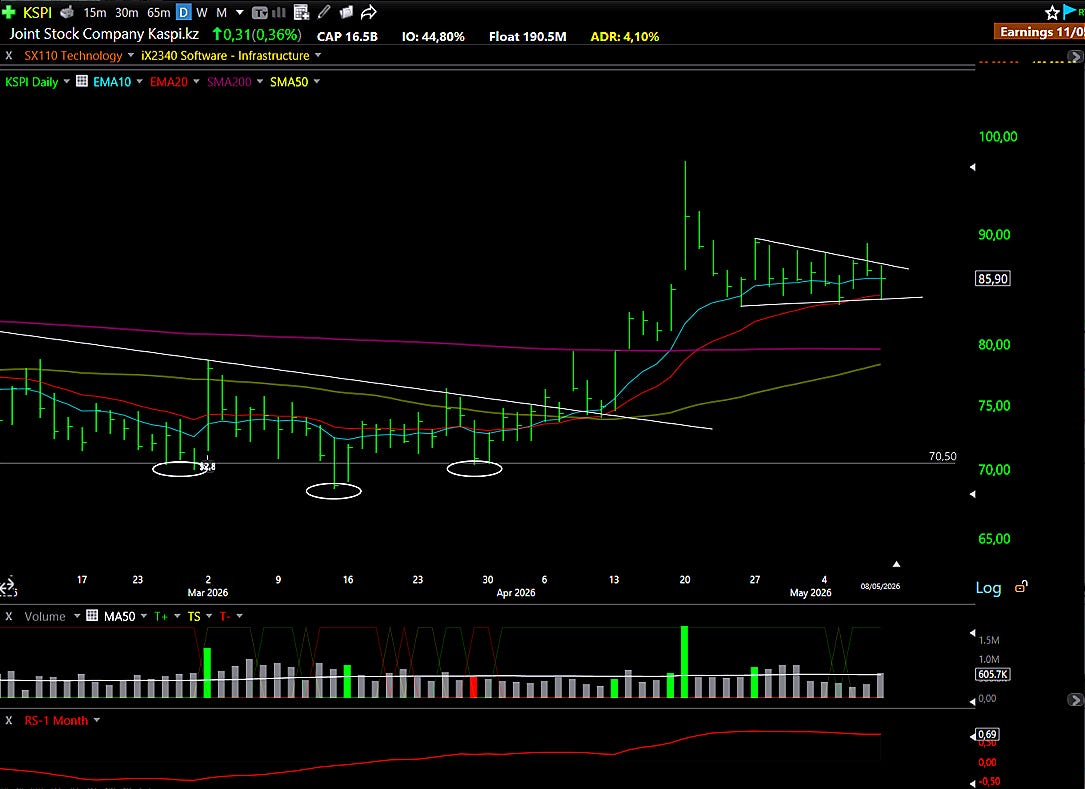
Technical Outlook: We had already added KSPI to our watchlist, and it played out exactly as expected. A very clean setup, even though we didn’t end up taking advantage of it ourselves. Now the stock seems to be positioning for another potential entry. After breaking out above 75.00, it has been consolidating in a very constructive way, tracking both the 10 and 20 EMA closely.
A move above 88.00 could open the door for a second leg higher.
These tickers below didn’t make the main cut, but they’re on our radar for a reason. We’ve vetted them; now you decide if they fit your game.
More opportunities, less noise.
⚡📋Scanned Stocks: Quick Picks
VELO - Velo3D Inc
TRT - Trio-Tech International
EVC - Entravision Communications
OKLO - Oklo Inc
CERS - Cerus Corporation
“Far more money has been lost by investors preparing for corrections than in corrections themselves.”
Peter Lynch
Disclaimer: This analysis is for informational purposes only and should not be considered financial advice. Always conduct your research and consult with a licensed financial advisor before making investment decisions.