


The April Rally That Left No Room
For those expecting a pullback, it was another relentlessly bullish week.
Instead of the pause many were waiting for, the market continued to push higher with very little friction. What we’re seeing increasingly resembles a classic lockout rally, the kind that leaves participants underexposed and struggling to find rational entry points.
These phases are rare, but not unprecedented.
Historically, similar environments have occurred during periods of extreme momentum, particularly in tech-heavy indices like the Nasdaq. There have been instances where the Nasdaq advanced close to 20% in the span of a single month, with only minimal retracements along the way. During those stretches, dips were shallow, short-lived, and often bought immediately, effectively locking out anyone waiting for cleaner setups.
That’s what makes this type of market so challenging.
When price moves in a near-linear fashion, without building structure or offering consolidation, it disrupts the natural rhythm most systematic approaches rely on. There’s no real opportunity to size properly without accepting elevated risk.
From a portfolio management standpoint, it becomes a difficult trade-off.

The trading week has been fairly intense by our standards.
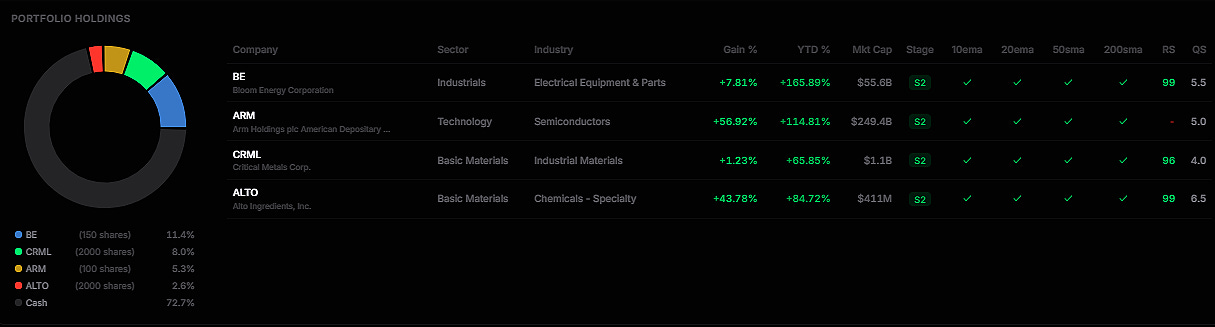
Three positions were closed, two new ones were initiated, and we significantly reduced what ended up being the main contributor to this week’s performance: Arm Holdings plc (ARM).
We are currently holding roughly 25% of the original position. We scaled out in three tranches, each representing 25% of the initial size, capturing gains of 11%, 17%, and 47% over just 11 trading days.
An exceptional outcome.
Probably one of the cleanest executions we’ve had in recent months. The position sizing was right from the start, the risk was well defined, and the broader market provided the tailwind. The theme was aligned with current narratives around CPU constraints, and the sector, semiconductors, was clearly in a position of strength.
When all those elements come together, the result can be powerful.

That said, we’re now leaning more defensive.
Not because we have a strong directional view, but because the market is showing signs of needing a pause. Extensions across the semiconductor space, in particular, are becoming difficult to justify from a sustainability standpoint.
Our system is currently flagging what we define as a maximum overextension signal across the sector. Historically, when this condition appears, a pullback tends to follow within three to five trading sessions.
It’s not guaranteed, but it’s consistent enough to demand respect.
Which brings us back to the same principle.
We don’t predict. We position.
And right now, patience remains the most rational trade.
Here’s a look at this week’s market health, with a breakdown of index and sector performance.


We’re currently building the beta version of our app, and it’s already live.
It is not a generic solution for every market participant, but a platform built specifically for swing trading, momentum strategies, and short to medium-term investing.
You can already sign up, access the beta, and start using it today.
As previously stated, all paid subscribers will receive full access to the platform at no additional cost.

Latest articles:


Each stock carries a risk badge: ⚠️ High | 📊 Medium | 🛡️ Low.
Based on volatility, float, technicals, and fundamentals. Size your positions accordingly.
📈 Free Setup: Make It Count
CRCL: Circle Internet Group Inc ⚠️
What they do: A financial technology company that issues and manages USDC
Why watch? Circle’s business model is refreshingly straightforward in an industry often characterized by complexity. The company takes real U.S. dollars, converts them into digital tokens called stablecoins (USDC being their flagship product), and parks the underlying cash in Treasury Bills. The interest earned on those T-bills is Circle’s primary revenue stream. Think of it as a money market fund with a digital wrapper: simple, transparent, and highly dependent on interest rates.
The distribution side of the equation matters too. Circle relies on crypto exchanges and other platforms to put USDC in front of users, and those distributors receive a share of the interest income as compensation. Profitability, therefore, comes down to whether the interest earned exceeds both distribution costs and operating overhead.
The elephant in the room is Tether, the global leader in dollar-pegged stablecoins. The key distinction between the two competitors is philosophical: Circle has built its entire brand around regulatory compliance and transparency, while Tether only recently announced plans to have its reserves independently audited. For years, questions have lingered about whether Tether actually holds the Treasury Bills it claims to back its tokens. Circle’s USDC carries a meaningfully lower risk of losing its dollar peg precisely because of this commitment to verifiable reserves, a distinction that matters enormously to institutional investors and regulators.
Two structural growth catalysts deserve attention. The first is asset tokenization: the process of representing real-world assets like real estate, bonds, or equities as digital tokens on a blockchain. Industry estimates put the eventual size of this market in the trillions of dollars, and stablecoins would serve as the settlement currency for these transactions, dramatically expanding demand for USDC. The second catalyst is the rise of agentic AI. Autonomous AI systems that execute financial transactions on behalf of users would naturally gravitate toward smart contracts, which settle instantly and programmatically. Stablecoins are the native currency of that ecosystem, and Circle sits at the center of it.
Technical Outlook: The stock has given back most of its gains from the earnings-driven surge earlier this year, but has found consistent support at the $85.00 level on multiple occasions, a clear line in the sand that also coincides with the 50-day simple moving average. For a stock with an 8% average daily range, the most recent session’s move of just 0.38% is remarkable compression. That kind of stillness in a volatile name typically precedes a meaningful directional move. The risk-reward in this handle formation is attractive, and the setup becomes actionable on a convincing break above the $100 to $102 range on elevated volume. If the broader market stabilizes and the stablecoin narrative continues to develop favorably, this could be one of the more important themes of the next several months.


Why We Don’t Wait for Sunday
Markets don’t move on your schedule. The best low-risk entries don’t announce themselves politely and wait for the weekend newsletter.
They show up when they show up. And if you’re not positioned, you miss them.
Paid members get real-time alerts: exact entries, stops, position sizing, and the thesis behind every trade. The same information we use to manage our own capital.
Free members get just one pick on Sunday.
Does that sound like an edge to you?
What’s Inside Premium
Free Access to TradeDeck
Premium members get early access to TradeDeck, the trading platform we’re building. The value of the platform alone already exceeds the cost of the subscription.
Watchlist Elite (5-7 Stocks)
Each selection undergoes rigorous financial analysis, technical evaluation, and strategic assessment.
Full Portfolio Transparency
Every position we hold. Entry price. Current P&L. Stop level. Real money, real risk.
Real-Time Trade Alerts (Chat Access)
This is where the edge lives. Exact entries, stops, and position sizing. Real-time. No lag
Quick Picks (5 Names)
Additional setups that just missed our main criteria but are worth watching.
Chat Access
See our thought process in real time. Ask questions. Watch how we manage risk.
The Tools We Actually Use
Member discounts on TC2000, Fiscal.ai, and other platforms. Same tools, better pricing.
What Paid Members Say:
We’re entrepreneurs first, traders second. We’ve sat in the CEO chair. We know what real execution looks like and how to spot it.
€39/month or 299€/year. Less than one losing trade. Cancel anytime.
Portfolio updates and new positions:

💎📈 Watchlist Elite: Premium Market Movers
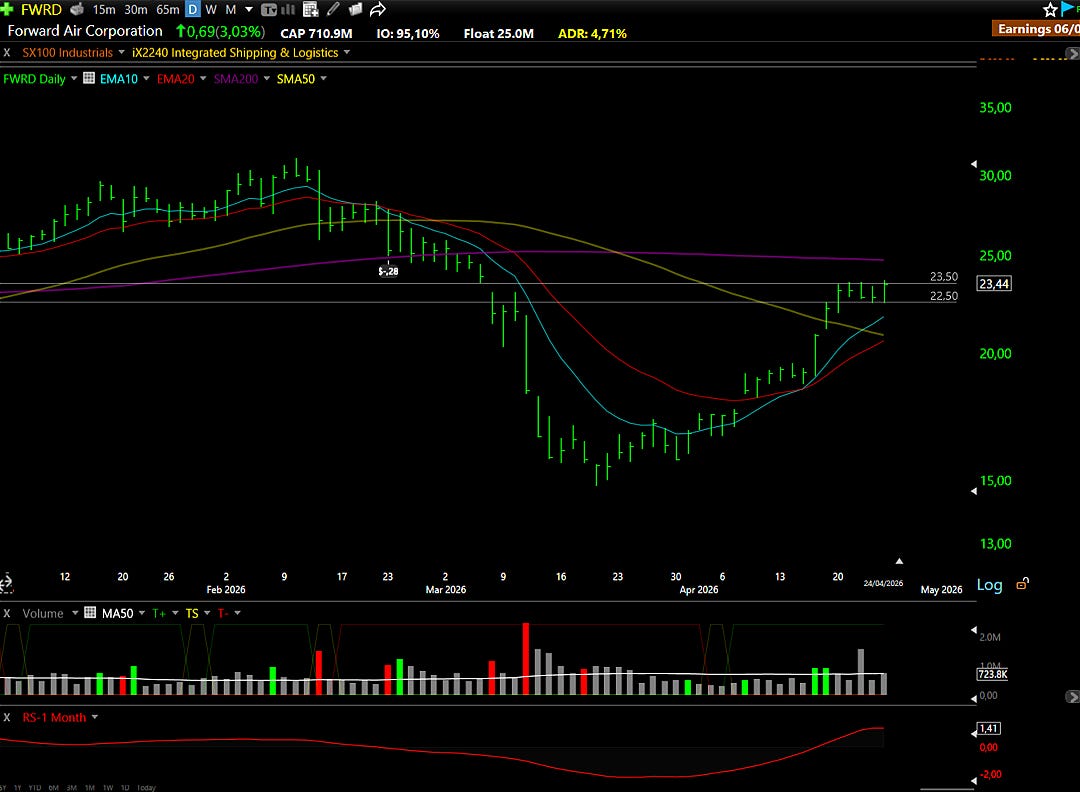
FWRD: Forward Air Corporation 📊
What they do: A logistics and freight transportation company
Why watch? The freight market is quietly entering what some analysts are calling a trucking super-cycle, and the market is only beginning to recognize it. Data center construction alone now accounts for roughly 10% of total freight market volume, and elevated energy prices are adding further demand pressure on transportation capacity. Forward Air is positioned to benefit from both trends, though its path to this point has been anything but smooth.
A brief history is necessary to understand the opportunity. In August 2023, Forward Air announced the acquisition of Omni Logistics, a private freight company, and the market responded harshly: shares fell from $110 to $70 almost immediately. The deal crossed the shareholder dilution threshold, triggering a mandatory shareholder vote, and the ensuing controversy was significant: the CEO resigned, lawsuits were filed, and the stock eventually collapsed to around $15. It was a messy, painful episode that left many investors permanently scarred by the name.
But underneath all that noise, the underlying business never stopped functioning. Forward Air’s core value proposition in LTL shipping (where multiple customers share space on a single truck moving in the same direction) is built around quality rather than price. The company targets the fewest lost, damaged, or late deliveries in the industry, a positioning that commands premium pricing and customer loyalty. Even through the turbulence of the recent past, the company generated approximately $30 million in free cash flow.
The valuation case is interesting. Forward Air has historically traded around 2.5 times Enterprise Value to Sales, and the current price represents a significant discount to that historical norm. If freight volumes recover over the next couple of years as expected, the company could pay down $250+ million in debt by the end of 2028 while revenues grow: a combination that could push the stock 50% or more above current levels.
Technical Outlook: The cup pattern is complete, and the stock is now forming a handle within an extremely tight one-dollar range between support and resistance. This isn’t the most exciting sector (freight and logistics rarely generate the enthusiasm that technology or AI names do), but that’s precisely where opportunity lives. The market hasn’t fully rewarded this recovery yet, which means the risk-reward remains favorable. The ideal setup would involve another week of consolidation, allowing the 10-day EMA to catch up to price, followed by a clean break above $23.50 on meaningful volume. That would signal that the handle is resolving to the upside and the next leg of the recovery is underway.
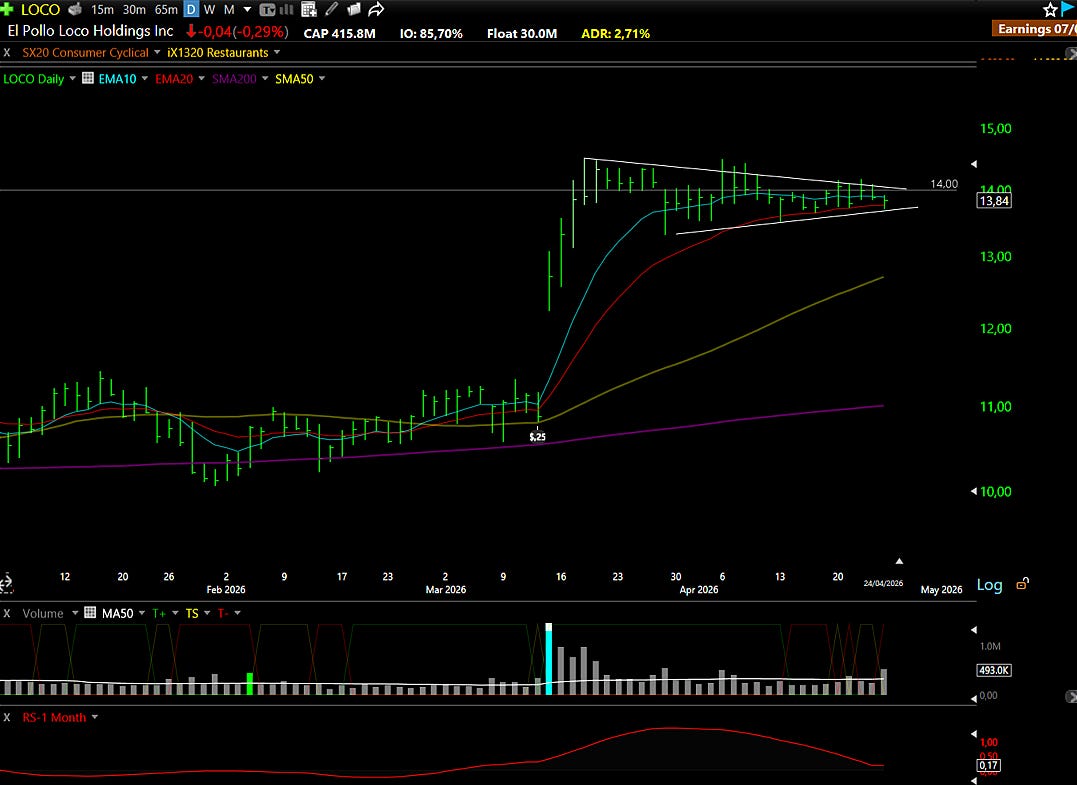
LOCO: El Pollo Loco Holdings Inc 🛡️
What they do: A fast-casual restaurant chain
Why watch? The restaurant sector has been under significant pressure since the start of the year, with a broad risk-off rotation hitting consumer discretionary names particularly hard. Against that difficult backdrop, El Pollo Loco is quietly executing a turnaround that deserves more attention than it’s currently receiving.
The most striking data point from the company’s recent earnings report is the gross margin recovery: from a troubling 19.8% in the second quarter to 45.4% in the fourth quarter. That kind of sequential improvement doesn’t happen by accident; it reflects deliberate operational changes taking hold. Management has been pulling several levers simultaneously: menu innovation centered on chicken tenders and bowls, loyalty program upgrades designed to drive repeat visits, and a general refocusing on what the brand does best. The CEO’s commentary struck a notably confident tone, describing “sustained momentum” that “validates our long-term growth strategy”, language that suggests management believes the worst is behind them.
The broader context matters here. El Pollo Loco is attempting to differentiate itself in a crowded fast-casual landscape at a time when consumers are becoming increasingly selective about where they spend discretionary dollars. The Southwest concentration is both a strength (deep brand recognition in core markets) and a limitation (constrained geographic expansion runway). But for a turnaround story, the focus right now should be on whether the operational improvements are durable, and the margin trajectory suggests they are.
Technical Outlook: The $14.00 level is the defining technical feature of this chart. Looking back at the monthly timeframe, this price acted as resistance throughout 2022 and again in 2024; the stock repeatedly tested it and failed to sustain a break above. That kind of multi-year resistance, when eventually cleared with conviction, often becomes equally strong support and signals a genuine change in the stock’s character. The stock has been consolidating around this level for approximately five weeks, and on the daily chart it’s surfing the 20-day EMA, which is now providing support very close to current prices. That proximity to support creates an attractive risk-reward entry. The trigger is straightforward: a convincing break above $14.00 accompanied by a meaningful pickup in volume would be the signal that something significant is developing.
MRLN: Merlin Inc ⚠️
What they do: A developer of AI-powered autonomous flight software and systems
Why watch? Most investors scanning the AI landscape are focused on software platforms, data center infrastructure, or semiconductor companies. Merlin represents something different: an early-stage company applying AI autonomy to one of the most demanding and consequential environments imaginable: commercial and military aviation.
Founded in 2017 by Matt George, who previously built a mobility company called Burdge, Merlin Labs has developed a product called Merlin Pilot: an integrated hardware and software system that handles the full flight envelope, from takeoff through navigation and air traffic communication to landing. The company went public recently and remains largely under the radar for most institutional investors, which is part of what makes it interesting.
What separates Merlin from the broader field of aviation autonomy startups is where it focuses its technology. The genuine bottlenecks in autonomous flight aren’t the basic mechanics of keeping an aircraft in the air. It’s situational awareness (understanding the full environment around the aircraft in real time) and air traffic control communication (the complex, often ambiguous radio exchanges between pilots and controllers). Merlin Pilot addresses both, including autonomous communication with air traffic control, a capability that most competitors haven’t cracked.
The real-world validation is what elevates this beyond the concept stage. Merlin already holds a $105 million framework contract to integrate autonomous flight technology into the C-130J aircraft used by U.S. Special Operations Forces—one of the most demanding operational environments in military aviation. GE Aerospace has also partnered with Merlin to incorporate AI into GE avionics, with an eye toward the upgrade program for the KC-135 tanker fleet. They represent actual flight hours and real government commitments.
In aviation, the critical barrier isn’t whether the technology works in a controlled setting. It’s whether it can achieve regulatory certification, a process that is notoriously slow, expensive, and unforgiving. Merlin is one of the very few startups actively navigating that certification pathway, which means if they succeed, they won’t just be another AI software company. They could become the foundational autonomy layer for the entire aviation industry, military and commercial alike.
This is an early-stage, high-risk investment. The company is pre-profitability, the regulatory path is long, and execution risk is substantial. But the addressable market, the existing government contracts, and the quality of the partnerships suggest this is a story worth following closely.
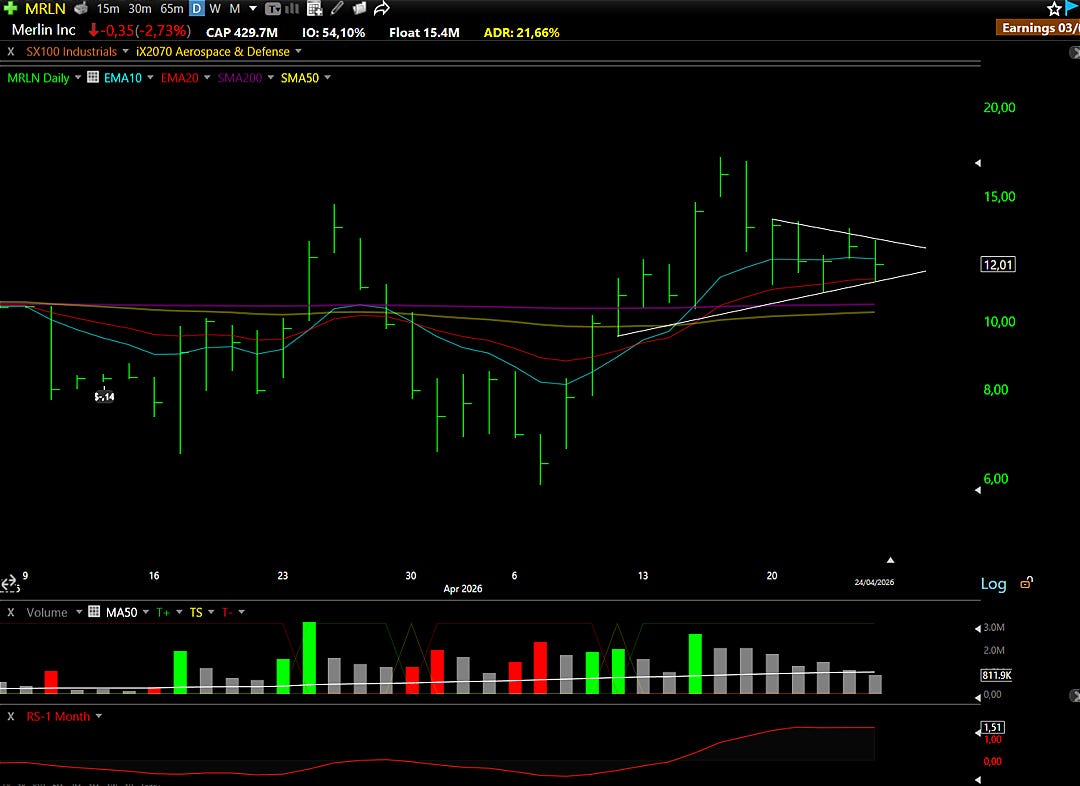
Technical Outlook: As a recent IPO, the chart history is limited, which makes technical analysis more art than science. Monitor volume patterns and price behavior around key post-IPO reference levels for early signals about institutional accumulation or distribution. Now 11.50 is the support, 13.00 is the resistance. Very low volume in the last three sessions.
AMBQ: Ambiq Micro Inc ⚠️
What they do: A semiconductor company designing ultra-low-power chips
Why watch? There’s a structural shift underway in how AI computation gets done, and it has significant investment implications. Today, most AI processing happens in massive data centers in the cloud. But that model has real limitations: latency (the delay between sending a request and receiving a response), cost, privacy concerns, and the simple reality that many devices operate in environments without reliable connectivity. The inevitable next step is moving AI inference (the process of running an AI model to generate outputs) directly onto the device itself.
The numbers behind this shift are striking. AI inference is projected to account for two-thirds of all AI compute by 2027, up from roughly one-third in 2023. The market for inference-optimized chips is expected to exceed $50 billion right now. Yet the public market options for investors wanting exposure to this specific trend remain surprisingly limited.
Ambiq went public in July 2025, raising $110 million. The company has already shipped ultra-low-power chips into 280 million devices, giving it a meaningful installed base and proven manufacturing relationships. At CES 2026, Ambiq unveiled Atomiq, described as the world’s first ultra-low-power neural processing unit system-on-chip. The device delivers over 200 billion operations per second of on-device AI performance while consuming minimal battery power: a combination that targets the wearables, augmented reality glasses, and industrial monitoring markets where battery life is a hard constraint.
Gross margins have expanded to 44.8%, a healthy trajectory for a company at this stage, though profitability remains ahead. The customer concentration risk is real; losing a major customer would have an outsized impact on revenue, and as with any recent IPO, the stock carries elevated volatility. Analyst price targets range from $40 to $48, suggesting meaningful upside from current levels. The stock is currently trading around $31, approximately 40% below its 52-week high.
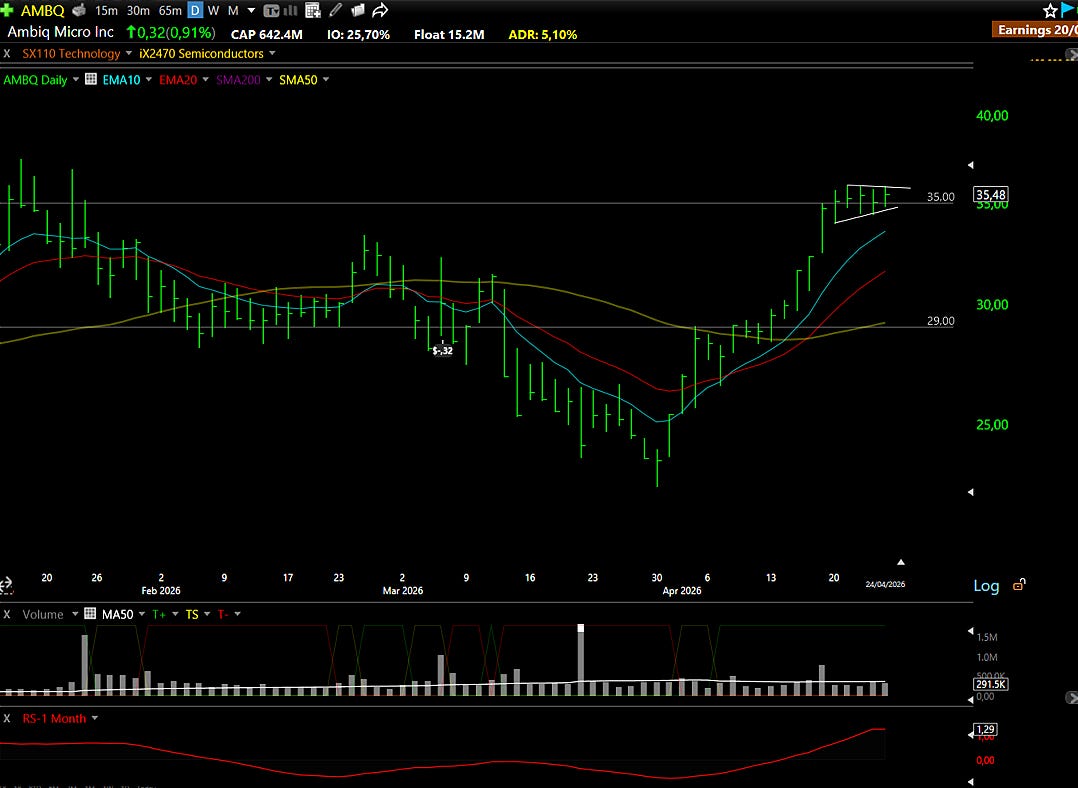
Technical Outlook: The stock is consolidating quietly on declining volume above the $35.00 level: a price point that served as significant resistance both in late 2025 and again in early 2026. When a former resistance level becomes support, it often marks a meaningful shift in the stock. A sustained hold above $35.00 would set up a potential run toward the IPO-day highs. The low-volume consolidation is constructive, suggesting sellers have largely been absorbed. This is a speculative position given the IPO vintage and the concentrated customer base, but for investors who believe edge AI is a durable theme, Ambiq offers one of the few pure-play entry points available in public markets today
These tickers below didn’t make the main cut, but they’re on our radar for a reason. We’ve vetted them; now you decide if they fit your game.
More opportunities, less noise.
⚡📋Scanned Stocks: Quick Picks
NEWP - New Pacific Holdings Corp
UNH - UnitedHealth Group Inc
GLXY - Galaxy Digital Inc
HIMS - Hims & Hers Health Inc
PLOW - Douglas Dynamics Inc
“There is nothing new on Wall Street.”
Jesse Livermore
Disclaimer: This analysis is for informational purposes only and should not be considered financial advice. Always conduct your research and consult with a licensed financial advisor before making investment decisions.