


The General Who Did Not Move
There is a particular kind of silence that only exists in the hour before something breaks.
Not peace. Not calm. Something tighter than that. The silence of a man who has made his decision and is now simply waiting for the world to catch up to it.
I have been in trading rooms when the tape starts going sideways. I have watched grown men, smart men, men with Ivy League degrees and Bloomberg terminals and twenty years of experience, completely come apart at the seams because the number on the screen was moving in the wrong direction. The instinct is primal, and it is almost impossible to fight.
Do something. Anything. Move. Reposition. Hedge. Call someone.
The anxiety of stillness in a volatile market feels physically indistinguishable from cowardice, and most people cannot tell the difference.
Sun Tzu could.
He wrote it down twenty-five centuries ago, in a chapter that most people skim because it doesn’t have the quotable aggression of the rest of the book.
“Ponder and deliberate before you make a move.”
Five words. No footnotes. No framework. No three-step process. He trusted that anyone who had ever stood on a real battlefield, with real consequences, would understand exactly what he meant without needing it explained.
The general he was describing wasn’t sitting still because he was afraid. He was sitting still because he understood something that the anxious men around him did not: that the battlefield punishes revelation. Every move you make before you are ready is information you hand to the enemy for free. Every repositioning born from panic rather than clarity is a resource burned, a position exposed, a card shown. The general who moves first out of anxiety doesn’t gain an advantage.
He just loses slower.
And then, in the same chapter, almost like he’s daring you to miss the point, Sun Tzu writes the other half of it: “When you move, fall like a thunderbolt.”
The two sentences are inseparable. The stillness is not the strategy. The stillness is what makes the strategy possible.
Right now, the market is doing what markets do when the world gets genuinely complicated. It is punishing everyone. The careful and the reckless, the hedged and the naked long, the guy who did his homework, and the guy who bought because his brother-in-law told him to. QQQ is down roughly five percent year to date. SPY is not far behind. There is a war unfolding in Iran, fear is moving through the tape like smoke through a building with no exits, and the financial media is doing what it always does in moments like this, which is to take the worst possible interpretation of every data point and present it as the only reasonable conclusion.
The noise is loud. It is designed, whether by intention or by the simple mechanics of how attention gets monetized, to make you feel like the worst possible outcome is the only possible outcome.
Our portfolio is up around six percent over the same period.

I am not telling you that to brag. Bragging is for people who need the validation. I am telling you that because it is the only honest way to explain what we actually do here, and what we are actually doing right now, which is nothing.
Deliberately, consciously, strategically nothing.
We are risk managers first. Portfolio managers second. In an environment like this one, the job is not to find the next great trade. The job is to keep the body count low. To play defense so well, so quietly, so without drama, that when the smoke eventually clears, we are still standing with enough capital to act. Most people get this backwards. They think the money is made in the buying. The money is protected in the waiting. Sure, we tried a couple of positions here and there, but nothing big.

There is a version of this story that gets told a lot in the financial world, usually by people who have never actually lived it. The version where discipline is clean and elegant and looks good in a presentation deck. Where you calmly identify the risk, rationally adjust your exposure, and move on with your day.
That is not what it feels like.
What it actually feels like is watching a position you believe in get hit for no reason other than macro fear, and sitting on your hands anyway. It feels like reading the headlines and feeling the pull, that old familiar pull, to do something, to prove you’re paying attention, to justify your existence as someone who manages money by making a move. It feels like the guy next to you at the terminal is repositioning and you’re not, and for a moment, just a moment, you wonder if you’re the idiot.
You’re not. But you have to be willing to sit with that feeling long enough to find out.
The market right now is a test of exactly that. Not intelligence. Not analysis. Not even conviction, really. It is a test of whether you can hold the shape of your thinking when everything around you is trying to deform it. Whether you can stay dark and impenetrable while the noise does its work. Whether you trust the preparation enough to wait for the moment rather than manufacturing one out of anxiety.
Most people fail this test. Not because they’re stupid. Because they’re human, and the human nervous system was not built for this particular kind of patience.
It was built for action. For response.
For the relief of doing something when something feels wrong.
Sun Tzu was writing for the rare ones who could override that. The generals who understood that the battlefield is not won by the man who moves first.
It is won by the man who moves right!
We are currently developing an application.
It is not a generic solution for every market participant, but a platform built specifically for swing trading, momentum strategies, and short to medium-term investing.
If we see meaningful interest, we will open a limited number of testing spots and allow selected users to access the platform early.
As previously stated, all paid subscribers will receive full access to the platform at no additional cost.


Latest articles:


Each stock carries a risk badge: ⚠️ High | 📊 Medium | 🛡️ Low.
Based on volatility, float, technicals, and fundamentals. Size your positions accordingly.
📈 Free Setup: Make It Count
IREN: IREN Limited ⚠️
What they do: A hybrid digital infrastructure company
Why watch? IREN’s second-quarter FY2026 earnings report, released in February, initially rattled investors. Revenue came in at approximately $184.7 million, missing Wall Street estimates by nearly 18%, and diluted earnings per share landed at -$0.52, also below expectations. On the surface, the numbers looked ugly. Yet within days, the stock had not only recovered but climbed back above pre-earnings levels: a telling sign that the market is looking past near-term results and pricing in a longer-term story.
The underlying business metrics were more encouraging than the headline numbers suggested. Adjusted EBITDA reached $75.3 million, up 20% year over year, reflecting genuine operational progress even as the company invests heavily in expanding its infrastructure footprint. The narrative around IREN has shifted meaningfully over the past year. What was once viewed primarily as a Bitcoin miner is increasingly being recognized as a data center infrastructure play with contractual AI revenue on the horizon. This reframing commands a very different valuation multiple.
A structural catalyst arrived on February 27, 2026, when IREN was added to the MSCI USA Index. For investors unfamiliar with the mechanics, this matters more than it might initially appear. A large universe of institutional and passive index funds is contractually required to mirror the composition of the MSCI USA Index. When a stock is added, those funds must purchase shares regardless of their own views on valuation or fundamentals: it’s a mandatory, price-insensitive buying event. This kind of forced institutional demand can provide meaningful support to a stock’s price and introduce a new, stable shareholder base.
Perhaps the most compelling data point from last week came on Friday, when IREN closed in positive territory while the major indices finished deeply in the red. In a market environment where investors are aggressively selling risk assets, a stock that holds its ground—let alone gains—is demonstrating genuine relative strength. The data center and AI infrastructure theme appears to be providing a durable floor under the stock.
Technical Outlook: The stock has already tested and bounced off the 200-day simple moving average once, a level that has historically attracted buyers in quality names. IREN is now trading near its anchored VWAP from the April 2025 lows, a reference point many institutional traders use to assess whether they are buying at a favorable average cost relative to long-term holders. If the broader market finds its footing next week, this confluence of technical support could serve as a strong launching pad. An undercut of recent lows followed by a sharp reversal would be the ideal entry scenario, shaking out weak hands before the next leg higher.


Why We Don’t Wait for Sunday
Markets don’t move on your schedule. The best low-risk entries don’t announce themselves politely and wait for the weekend newsletter.
They show up when they show up. And if you’re not positioned, you miss them.
Paid members get real-time alerts: exact entries, stops, position sizing, and the thesis behind every trade. The same information we use to manage our own capital.
Free members get just one pick on Sunday.
Does that sound like an edge to you?
What’s Inside Premium
🚀Free Access to TradeDeck
Premium members get early access to TradeDeck, the trading platform we’re building. The value of the platform alone already exceeds the cost of the subscription.
📊 Watchlist Elite (7-9 Stocks)
Each selection undergoes rigorous financial analysis, technical evaluation, and strategic assessment.
💼 Full Portfolio Transparency
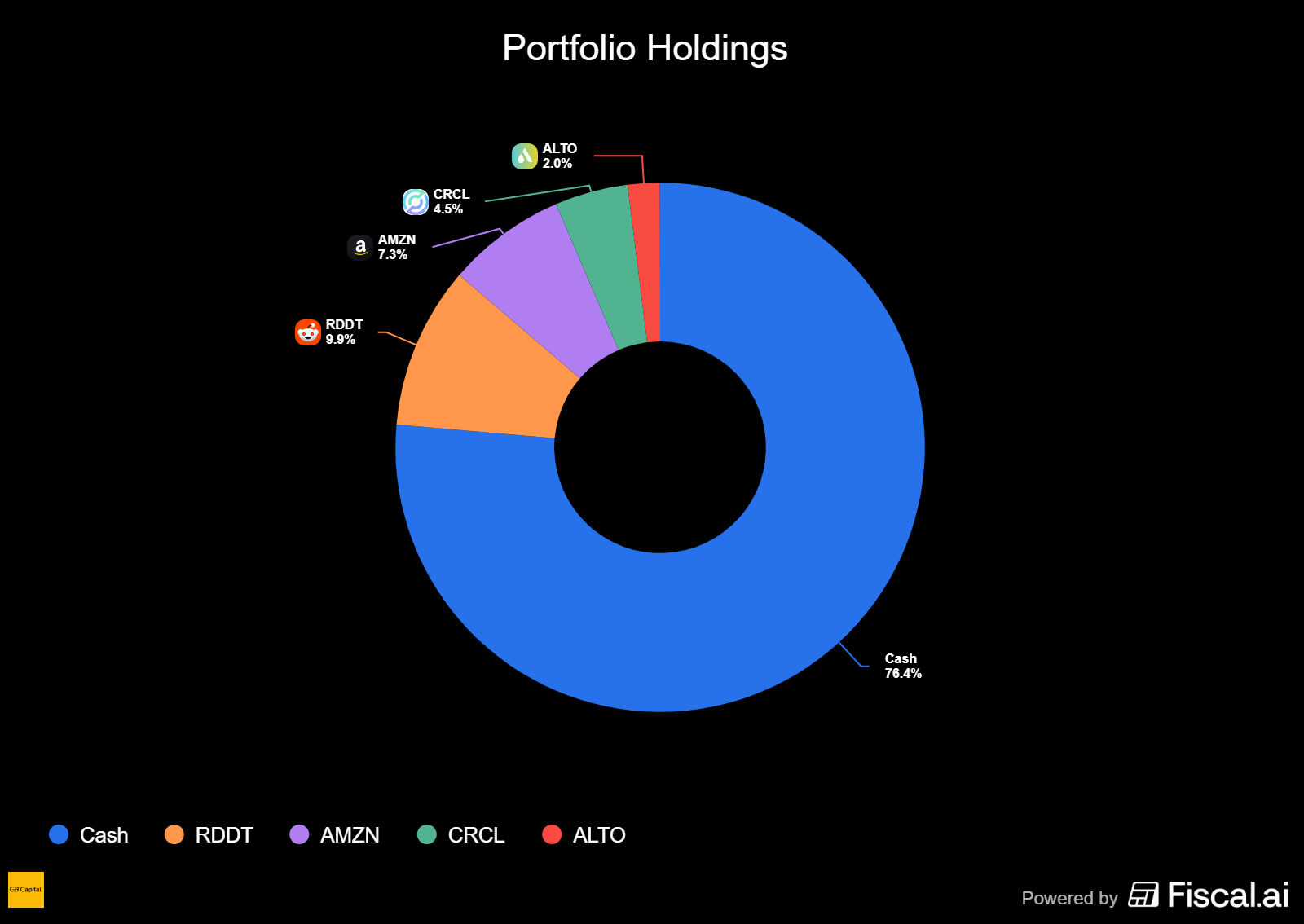
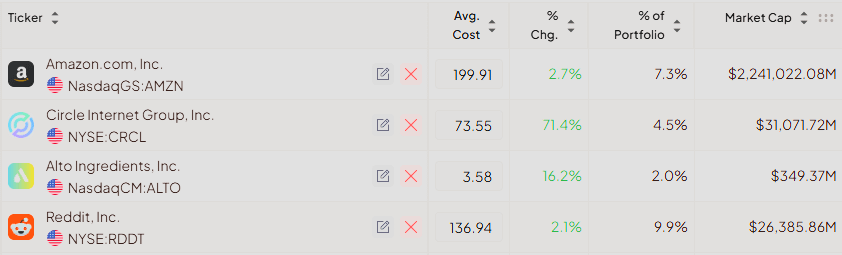
Every position we hold. Entry price. Current P&L. Stop level. Real money, real risk.
⚡ Real-Time Trade Alerts (Chat Access)
This is where the edge lives. Exact entries, stops, and position sizing. Real-time. No lag
🎯 Quick Picks (5 Names)
Additional setups that just missed our main criteria but are worth watching.
💬 Chat Access
See our thought process in real time. Ask questions. Watch how we manage risk.
🛠️ The Tools We Actually Use
Member discounts on TC2000, Fiscal.ai, and other platforms. Same tools, better pricing.
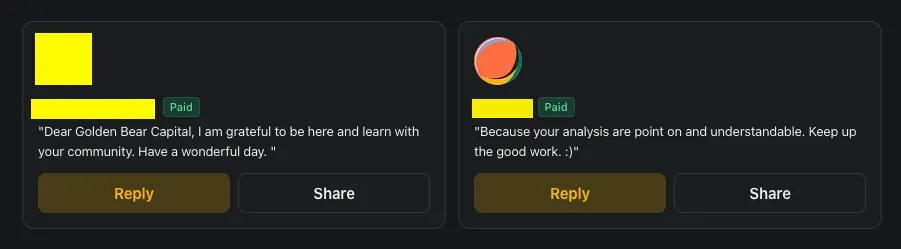
What Paid Members Say:
We’re entrepreneurs first, traders second. We’ve sat in the CEO chair. We know what real execution looks like and how to spot it.
€39/month or 299€/year. Less than one losing trade. Cancel anytime.
Portfolio updates and new positions:

⚡ AI-optimized, human-verified: Our expert team carefully selected Premium market intelligence from Fiscal.ai data. Explore now →
💎📈 Watchlist Elite: Premium Market Movers
PINS: Pinterest Inc 📊
What they do: A visual discovery and social commerce platform
Why watch? Few stocks in the technology sector tell a more striking story of valuation dislocation than Pinterest. Shares that traded near $90 in 2021 had collapsed to approximately $13 by early 2026 (a decline of roughly 85%) despite the company posting record user engagement and steadily improving profitability throughout that period. The culprit was fear: specifically, the market’s concern that AI-powered search and discovery tools would render Pinterest’s model obsolete before it could fully monetize its audience.
That fear may have created one of the more compelling value opportunities in the large-cap internet space. At $18 per share, the disconnect between Pinterest’s financial performance and its market valuation had become difficult to ignore. The company generated free cash flow of $1.25 billion in its most recent fiscal year, representing a free cash flow margin of 30%, a record for the company and a figure that would be the envy of most software businesses. That free cash flow grew 33% year over year, suggesting the business is not only profitable but accelerating.
The catalyst that appears to have shifted sentiment came in the form of a $1 billion investment from Elliott Management, one of the most respected and feared activist investors on Wall Street. Elliott will receive convertible senior notes carrying a 1.75% coupon over a five-year term, with the right to convert those notes into Pinterest shares at approximately $22.72 per share: a 30% premium to the closing price before the announcement. When an activist of Elliott’s caliber makes a billion-dollar bet with a conversion price 30% above market, it sends a clear message about where they believe the stock is headed.
Pinterest intends to deploy the proceeds toward a $3.5 billion share repurchase program, including $2 billion in near-term buybacks with $1 billion accelerated. Aggressive buybacks at current prices would be meaningfully accretive to per-share value, effectively allowing the company to retire a significant portion of its float at what management clearly views as a discount to intrinsic value.
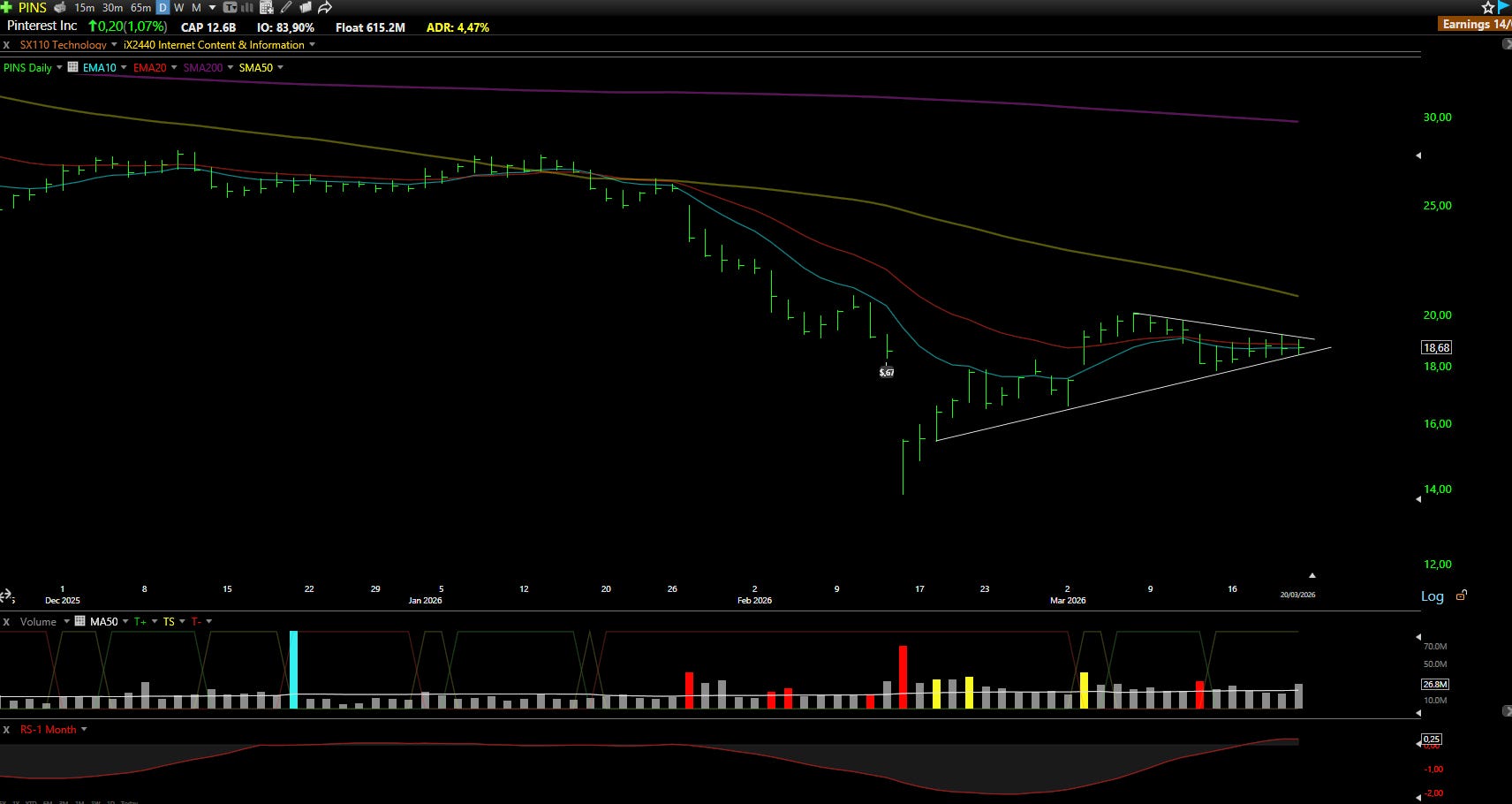
Technical Outlook: Since mid-February, the stock has been carving out a series of higher lows, unwilling to retrace to prior support levels. The price is now consolidating tightly near the 10-day and 20-day exponential moving averages, which are beginning to flatten and turn upward. Like IREN, Pinterest demonstrated notable resilience on Friday, gaining approximately 1% while the broader market sold off sharply. The key level to watch is $19.00: a clean break above this level on expanding volume would signal that the consolidation is resolving to the upside and could mark the beginning of a more sustained recovery.
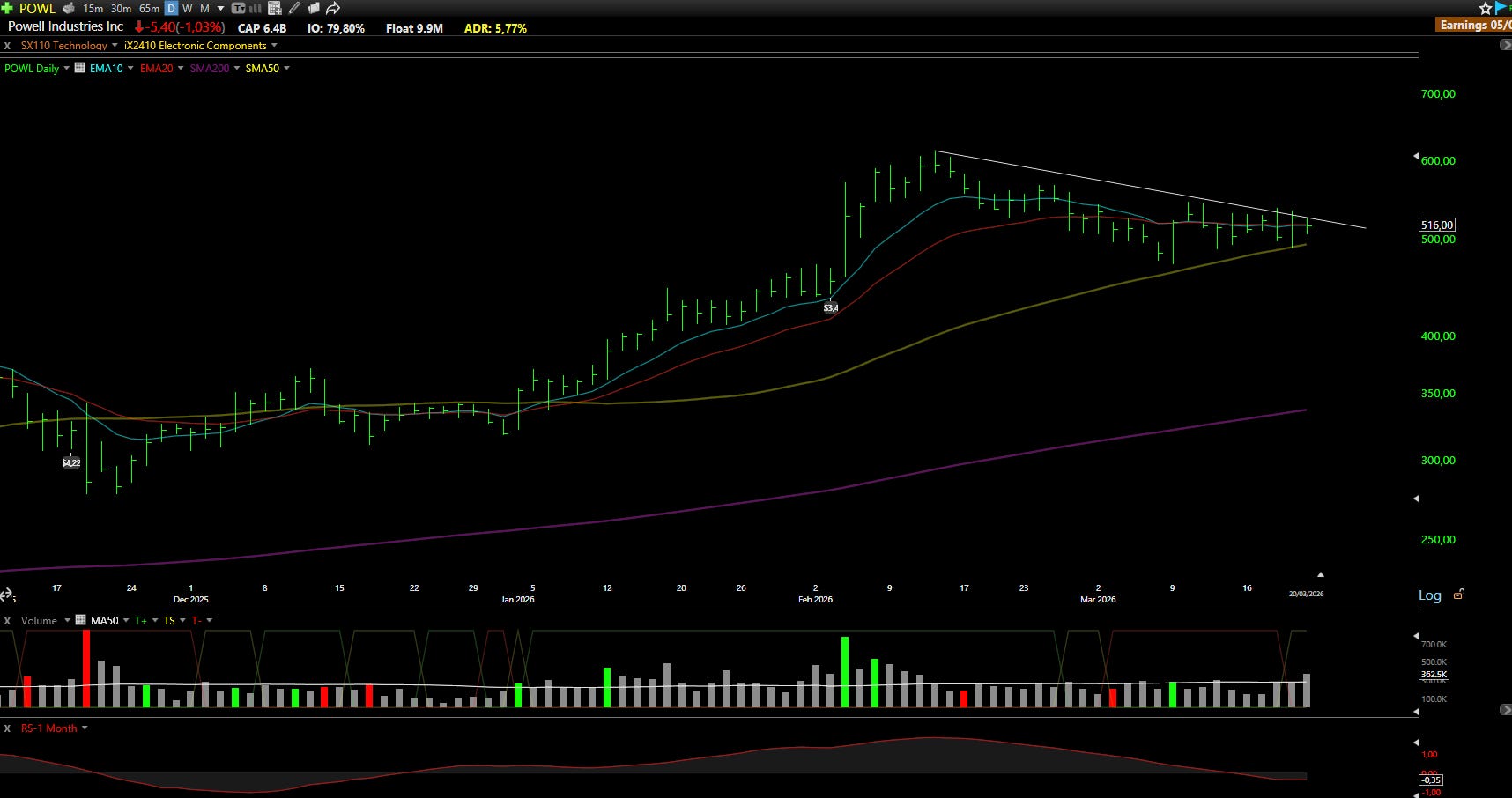
POWL: Powell Industries Inc 📊
What they do: A manufacturer of electrical distribution equipment and systems
Why watch? Powell Industries has been one of the standout performers in the industrial sector, with shares up approximately 60% year to date. The rally isn’t speculative: it’s grounded in fundamental business momentum that reflects the company’s positioning at the intersection of two of the most powerful capital spending themes in the current market: artificial intelligence infrastructure buildout and grid modernization.
The first quarter of fiscal 2026 delivered results that validated the enthusiasm. New orders grew 60% year over year, and the company’s backlog expanded 15% over the same period. Management expressed confidence in the outlook across all end markets through the full fiscal year, a notably optimistic tone for a company that tends toward conservative guidance. Revenue reached $251.2 million, with the electric utility and oil and gas segments contributing meaningfully to the mix. The electric utility segment alone accounted for 35% of total revenue, underscoring how central grid infrastructure spending has become to Powell’s growth story.
The capital allocation picture is equally compelling. Management is evaluating a potential $100 million investment in a new manufacturing facility to support what they describe as multiyear demand growth. Critically, the company holds approximately $500 million in cash on its balance sheet, more than sufficient to fund this expansion without taking on debt or diluting shareholders. This financial flexibility gives Powell the ability to invest aggressively in capacity while maintaining a fortress balance sheet, a combination that is increasingly rare among industrial manufacturers.
The broader context matters here. The AI buildout requires not just servers and chips, but an enormous amount of electrical infrastructure to power and distribute energy to data centers. Powell’s specialized electrical distribution systems sit directly in the path of this spending wave, and the company’s growing data center exposure suggests management has been positioning for this opportunity for some time.
Technical Outlook: The stock has found support at the 50-day simple moving average on two separate occasions recently, each time attracting buyers at that level with conviction. On Thursday, the stock printed a textbook hammer candlestick pattern (a formation that signals potential exhaustion of selling pressure) right at the 50-day moving average. Friday was followed by an inside day, indicating a pause and compression before the next directional move. The 10-day and 20-day exponential moving averages are also converging nearby to provide additional support. The stock is now approaching a descending trendline that has capped rallies in recent weeks. A break above that trendline, particularly if accompanied by broad market strength, would represent an attractive risk-reward entry with a well-defined stop below the recent lows.

Put the market on autopilot, experience the Best Platform with TC2000
Explore now →
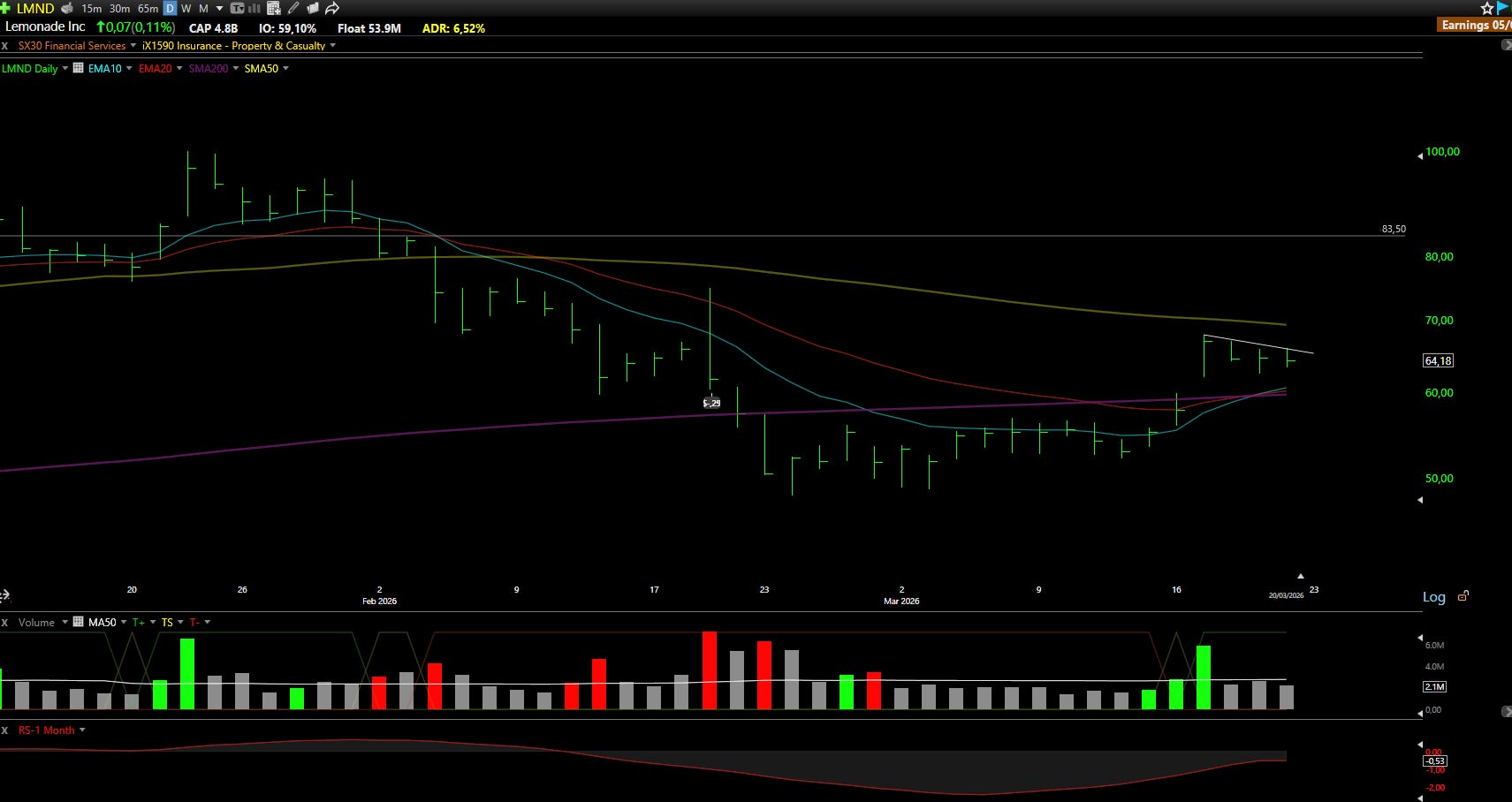
LMND: Lemonade Inc 📊
What they do: A technology-driven insurance company
Why watch? The dominant fear gripping markets in early 2026 is that AI will disrupt and displace established businesses across virtually every sector. The irony in Lemonade’s case is that this fear has hammered a company that is actually one of the more genuine practitioners of AI in financial services. Lemonade isn’t threatened by AI; it has been building its entire operating model around it for years, using machine learning to automate underwriting, streamline claims processing, and reduce the operational overhead that burdens traditional insurers. The selloff has created a situation where a company that should benefit from AI adoption is being punished alongside companies that might be harmed by it.
The path to profitability is becoming clearer. Management has set a target of reaching adjusted EBITDA profitability by early 2027 at the latest, and two specific business developments are accelerating that timeline. The first is the explosive growth of Lemonade’s pet insurance division, which has expanded 50% year over year and has grown to become the company’s second-largest product line. What began as a niche offering has evolved into a meaningful revenue contributor, and the category benefits from strong customer retention and relatively uncorrelated risk compared to property insurance.
The second driver is a strategic shift in how Lemonade manages its reinsurance arrangements. Reinsurance is essentially insurance for insurance companies: a way to transfer risk to third parties in exchange for sharing premium revenue. Lemonade had historically ceded 55% of its premiums to reinsurers, a conservative approach appropriate for a young company still building its actuarial track record. Beginning in the third quarter of this year, the company reduced that cession rate to just 20% for new policies. As Lemonade has scaled, particularly in lower-correlated risk categories like pet and auto insurance, management has grown confident enough in its risk models to retain more of the economics. This shift will serve as a meaningful tailwind to revenue and margins until it is lapped in the third quarter of next year.
Technical Outlook: After an extended decline, the stock appears to have found a durable floor near the $50 level and is now consolidating constructively below the $66 resistance zone on declining volume: exactly the kind of quiet, low-energy consolidation that often precedes a meaningful move higher. The stock has reclaimed both the 10-day and 20-day exponential moving averages as well as the 200-day simple moving average, all of which now provide support below current prices. The 50-day simple moving average, sitting near $70, represents the next meaningful resistance level. The current tight flag pattern, if it resolves to the upside with expanding volume, could mark the beginning of a more sustained recovery toward that target and potentially beyond.
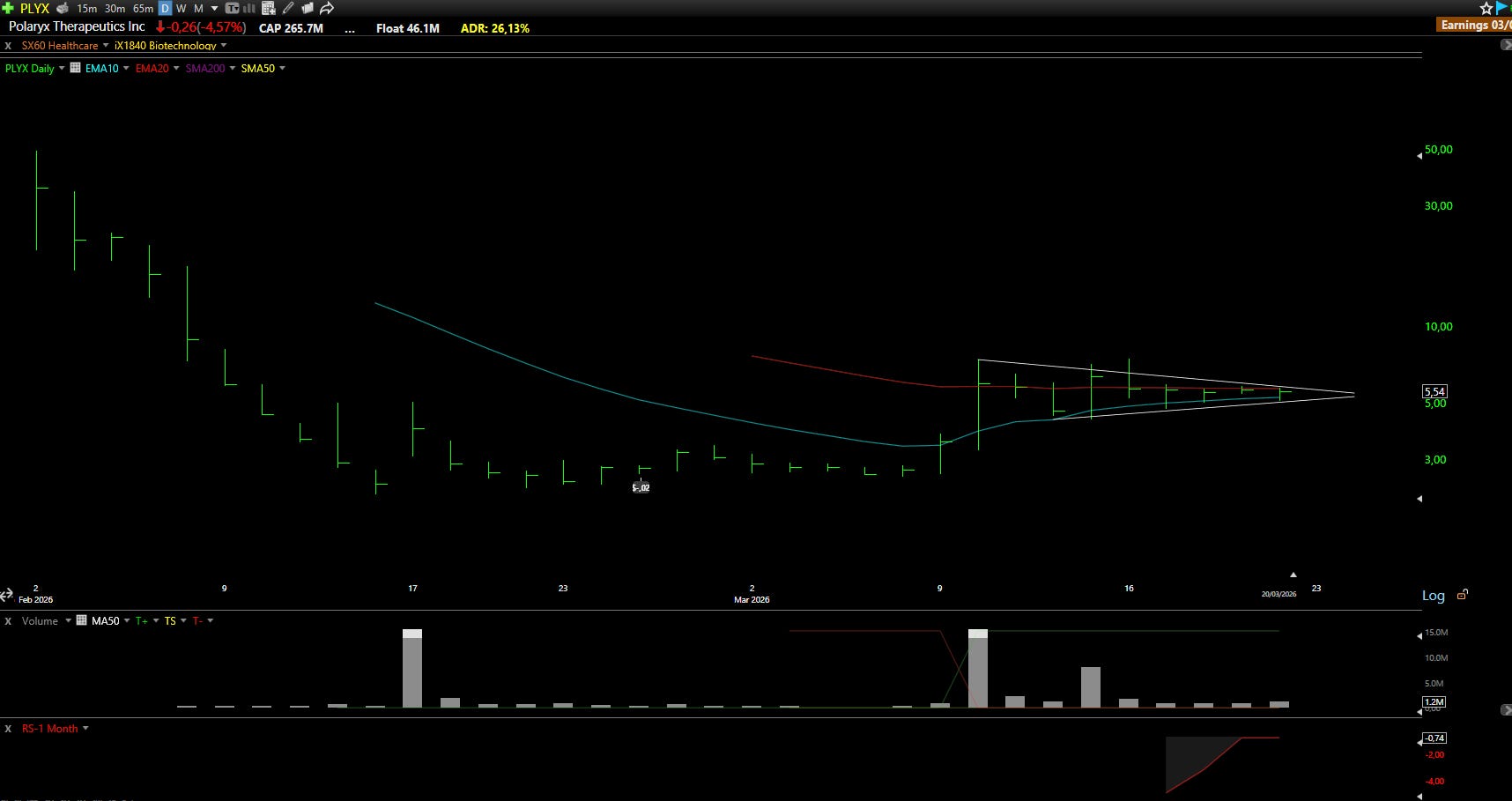
PLYX: Polaryx Therapeutics Inc ⚠️
What they do: A clinical-stage biopharmaceutical company
Why watch? Lysosomal storage disorders are a collection of rare genetic conditions that affect multiple organ systems and, in certain subtypes, occur at significantly higher rates among Ashkenazi Jewish populations than in the general public. While individually rare, these conditions collectively represent a substantial and growing commercial opportunity. According to 2025 market research, the global lysosomal storage disorder treatment market was valued at approximately $4.5 billion in 2024 and is projected to exceed $6.5 billion by 2033. The growth is being driven by improving diagnostic capabilities, innovation in treatment modalities, and rising awareness of rare genetic diseases among both physicians and patients.
Polaryx came to market through a direct listing rather than a traditional IPO, which carries an important implication for investors: there are no lock-up periods for company insiders, shareholders, or executives. All shares are registered and available for sale from the first day of trading. This structure removes the artificial supply constraint that typically supports newly listed stocks in the weeks following a conventional IPO, and investors should factor this into their risk assessment.
To be direct about the investment case: this is a pure speculative trade based on technical setup rather than fundamental conviction. There is no meaningful financial history to analyze, no commercial revenue, and the clinical pipeline is early-stage. Holding this stock for fundamental reasons would be difficult to justify at this point in the company’s development. The opportunity, if it exists, is entirely in the chart.
Technical Outlook: For a fresh IPO, the technical setup is genuinely interesting. Following an initial sharp move higher after listing, the stock has settled into a remarkably tight consolidation on very low volume, with the 10-day exponential moving average providing consistent support. This kind of quiet, orderly digestion of gains in a newly public company is relatively uncommon and suggests that sellers are not rushing for the exits. The average daily range is approximately 26%: an extraordinary figure that demands respect and careful position sizing. A stock that can move 26% in a single session can inflict serious damage on an oversized position. If the consolidation resolves to the upside with a volume expansion, the potential reward is significant. But this is firmly in the high-risk, high-reward category, and sizing should reflect that reality accordingly.
These tickers below didn’t make the main cut, but they’re on our radar for a reason. We’ve vetted them; now you decide if they fit your game.
More opportunities, less noise.
⚡📋Scanned Stocks: Quick Picks
ANTX - AN2 Therapeutics Inc
SNSE - Sensei Biotherapeutics Inc
ATOM - Atomera Incorporated
COIN - Coinbase Global Inc
BSY - Bentley Systems Inc
"The stock market is a no-called-strike game. You don’t have to swing at everything. You can wait for your pitch."
Jesse Livermore
Disclaimer: This analysis is for informational purposes only and should not be considered financial advice. Always conduct your research and consult with a licensed financial advisor before making investment decisions.