The Vertigo Shot
In Vertigo, Hitchcock and his cameraman Irmin Roberts wanted to put a man’s fear of heights on screen, and they did it with a camera trick. The camera pulls back while the lens zooms in, at the same rate. The subject stays exactly the same size in the frame while the space around it changes shape. The shot has been copied in Jaws and in Goodfellas. Viewers feel their stomach turn without knowing why, since the one thing they are looking at hasn’t moved.
That is what the market has looked like for weeks.
The indices are the subject, locked in the middle of the frame, close to their highs. Everything behind them has changed shape.
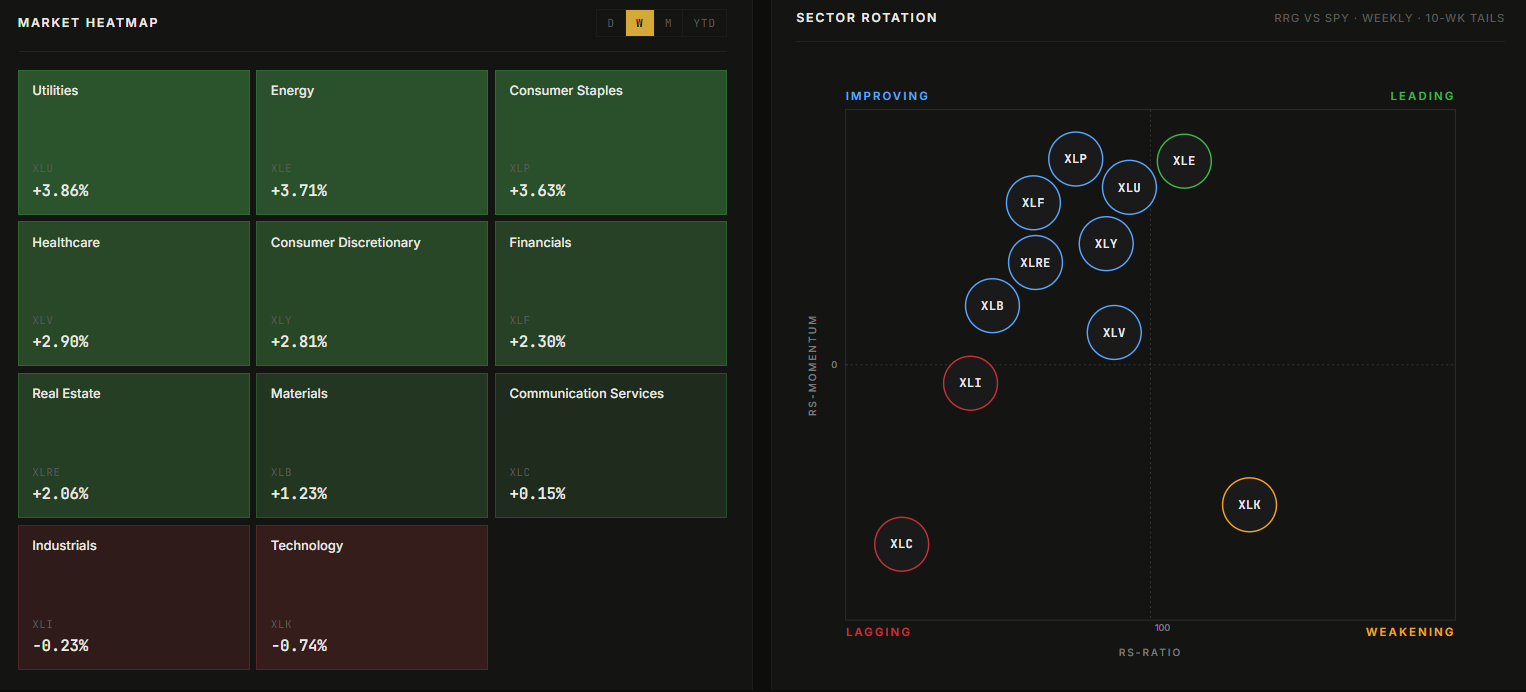
An index is weighted by size, so a few giant companies and very few industries can hold the number up while most of what sits underneath goes nowhere. Cybersecurity is the best group on our screens. Software and the oil and gas names are the other places holding up, the latter for obvious reasons, with the blockages in the Strait of Hormuz still in place. Small caps are in serious trouble. The speculative corners like quantum computing, data centers, drones, memory and storage, all gave back around ten percent in this one week!
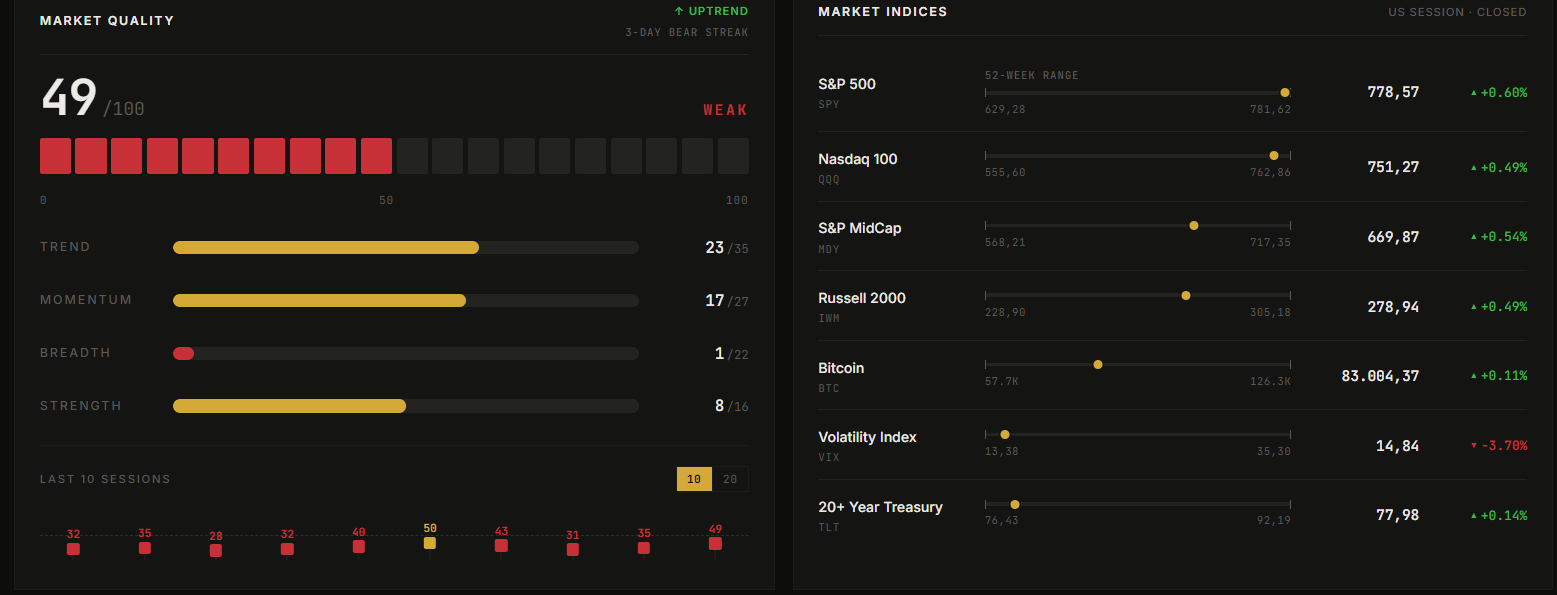
TradeDeck has been recording the same picture in numbers, with a record run of negative readings. Of the last twenty sessions our quality score reached 50 out of 100 only twice, and 50 still doesn’t count as bullish momentum (70 is the minimum threshold)
Breadth improved a little over the past week on our TC2000 scans, which is as far as we’d take it.

We are inside the shot with everyone else.
Several of our positions failed this week and one survived, and it has been two or three months since this market gave us any real traction. Anyone telling you they made great gains recently is lying or playing with Monopoly money. Or it’s just a super day-trader?
The traders we speak with say the same thing, and some are already comparing this to speculative bubbles!
In fifteen years of following markets we have never seen anything like it, least of all with the indices this close to their highs. A bear market at least tells you where down is. This one only tells you that something is off, and that is much harder to trade.
In the film the nausea is the point. If this market has been making you queasy, you are reading it correctly. Hold on, and keep looking at what is behind the index, not only at the index.

Here’s a look at this week’s market health, with a breakdown of index and sector performance.
📈 Free Setup: Make It Count
CRDO: Credo Technology Group
What they do: A semiconductor company making the cables, chips and optical parts
Why watch? The market has decided Credo is a copper business about to be made obsolete by fibre. Optics has gone from about 6% of its revenue last year to roughly 24% this year.
Copper is still the larger half. An AEC, or active electrical cable, is copper with silicon inside it. Chips called SerDes sit in the connector and encode and retime the signal so that it arrives clean at speeds plain copper cannot hold. AECs tie GPUs, CPUs, servers and switches together inside a rack or across to the one next to it, and their advantage is physical and narrow. Over short runs, out to about 7 metres, they burn roughly 25% less power than the optical equivalent and they fail less often, because there is no laser in them to fail. When you have tens of thousands of GPUs in a building, the hop from a GPU to its nearest switch is precisely where you want fewer lasers. That is why AECs are forecast to compound at 45% a year from 2024 to 2028 while active optical cables grow at 15%, taking share from optical and from passive copper alike. The 1.6T version running 200G per lane now reaches 7 metres, better than the 5 the market had assumed.
The bear case says fibre swallows all of this, and it misreads how a data centre is wired. AECs do scale-out, the cabling that links many GPUs, servers and racks into a single machine. Optics does scale-up, the links between accelerators, and Credo sells into that as well. Management has stood behind $600 million of optical revenue in fiscal 2027, with ZeroFlap Optics, silicon photonics PICs and optical DSPs each clearing $100 million. DSP revenue set a record last quarter and the first 1.6T DSP sales arrive before year end. The more durable piece is what sits above the hardware. Credo now tunes the DSP and the photonics chip as a single unit and ships them with its own firmware, telemetry and PILOT software, which tells the operator which link in the building is degrading and why. Once a hyperscaler’s technicians are chasing faults through your software, pulling you out costs more than the cable is worth.
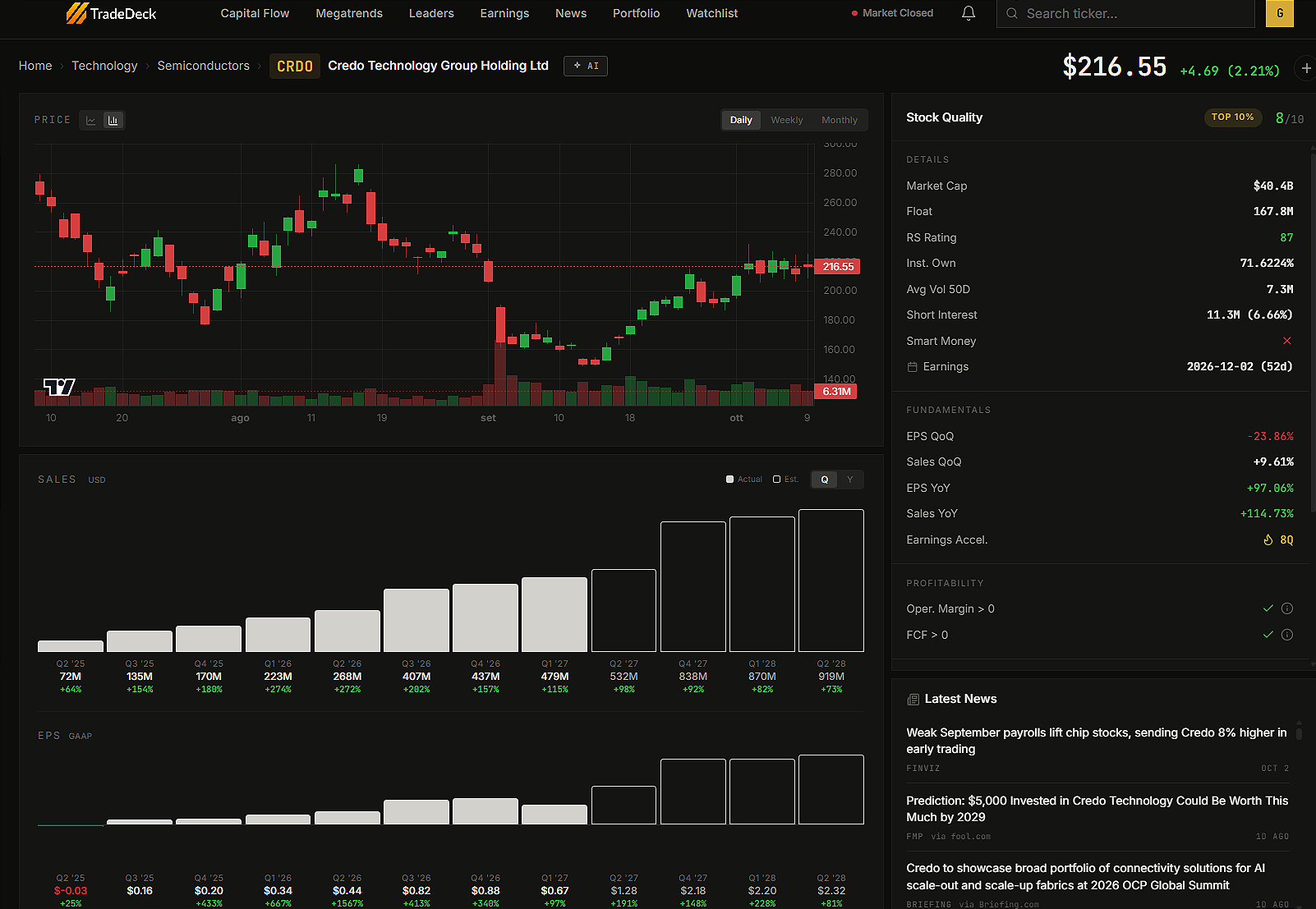
First quarter fiscal 2027 revenue was $479 million, up 115% on the year and 10% on the quarter, the seventh straight quarter of triple-digit growth, with $525 million to $535 million guided for the second. Gross margin came in at 64.5% against 67.4%, almost all of the difference being amortisation, and management guides it back to 67% to 69%. Free cash flow was around $83 million against $177.5 million the quarter before, because inventory rose $62.2 million, which is what a company does when it expects the orders to keep arriving. There is $764 million of cash against $26.2 million of debt, nearly all of it lease obligations, and nothing owed to a bank. At $216.83 the shares sit at 34.4 times fiscal 2027 earnings, 22.4 times 2028 and 17.4 times 2029, against revenue growth expected at 87% this year and 55% next.
A second business is forming alongside all that, and nobody is paying for it yet. AI inference runs out of memory as readily as it runs out of processing power. HBM, the fast memory stacked beside an accelerator, is expensive and permanently scarce. LPDDR, the memory in your phone, costs a fraction as much, and the obstacle has always been wiring enough of it in without building an interface nobody can manage. Credo’s Weaver gearbox funnels many LPDDR devices through far fewer high-speed links, with a claimed ten times the interface density of standard LPDDR5X. HBM keeps doing its job, and what Weaver adds is a large pool of cheap memory sitting next to it. Positron is the first customer, with an architecture built around roughly 2TB of LPDDR per processor, which management puts at $2,000 to $3,000 of Credo content per GPU. Positron raised $875 million at a $5 billion valuation in September, already runs more than 50 racks of its older Atlas systems at Oracle Cloud Infrastructure, and takes its next processor, Asimov, into production in the second half of 2027. At $2,500 a processor, 100,000 processors would come to $250 million, about a tenth of this year’s revenue. None of it is in anyone’s model, which is the right way to carry it.
Two things could go badly wrong. Four customers made up about 80% of last quarter’s revenue, and management expects three or four of them to stay above 10% each all year, so a couple of postponed hyperscaler orders would take the growth rate apart. And stock compensation is running at roughly 20% of revenue. More than half goes into R&D, normal enough for a chip designer.
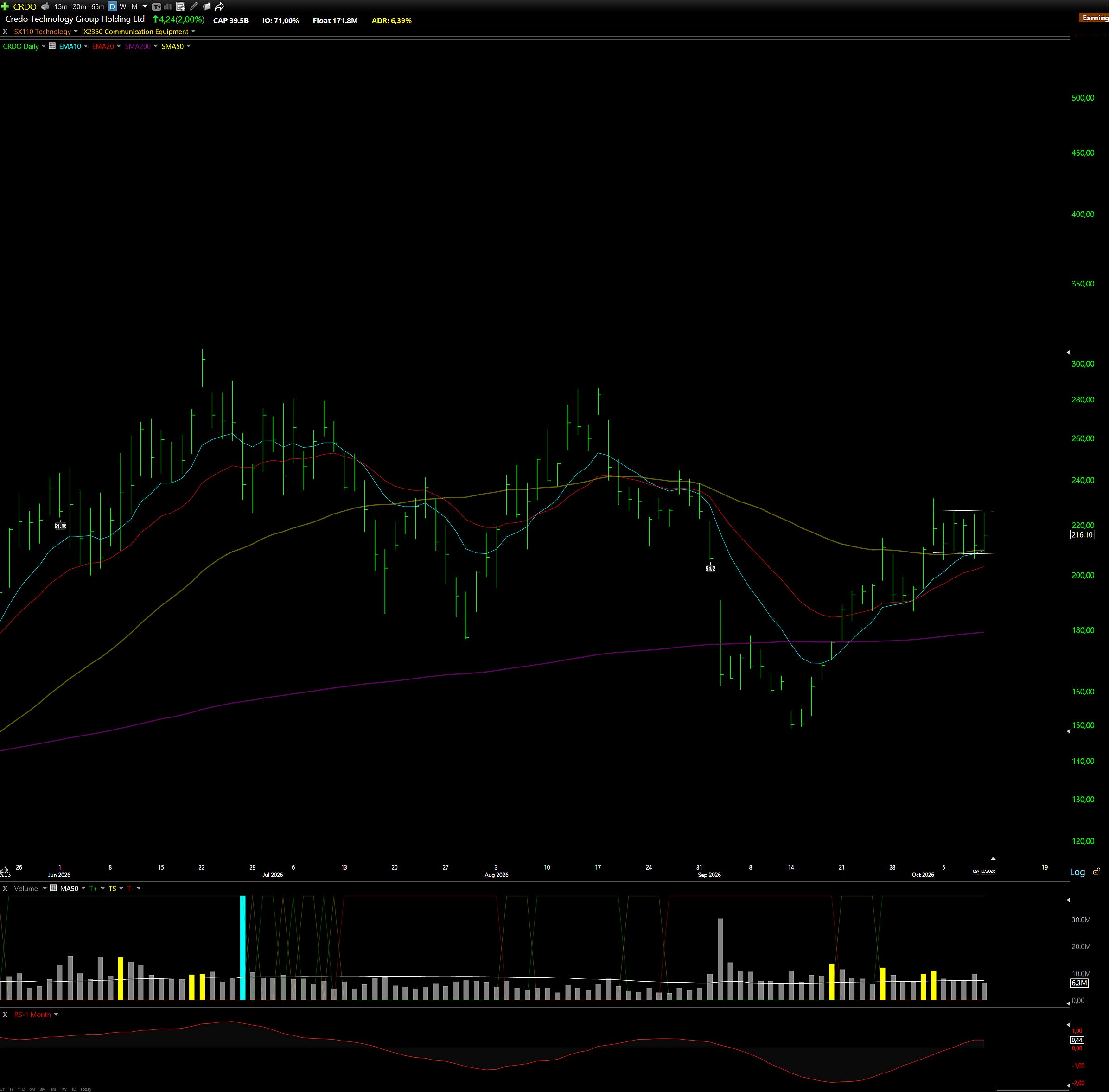
Technical Outlook: The stock has gone essentially nowhere since June. Across the stretch from May to now it has covered a very wide range between roughly $150 and $290 without settling it, and from June to mid-September it dropped about 50% before clawing part of it back. What it has never had is a breather, because every big push has been met with a big drop and no time in between to build a base. That begins to change this week. After a small move off the recent lows, price is consolidating in a tighter range, held up by a rising 10-day EMA and by the 50-day, which was resistance into the end of September and is now acting as support alongside the 10. This is not one of the better setups of the week, and the volatility is why. What we want is another three or four days inside the box now forming, with support around $200 to $205 and resistance around $225, before it commits to a direction. If that direction is up, the objective is reclaiming $280 to $290, with $287 the first level of consequence and then $300 and $308 to $309 above it.

What €39/month (or 299€/year) buys:
Free Access to TradeDeck
Premium members get full access to the trading platform we’re building. The value of the platform alone almost exceeds the cost of the subscription.
Watchlist Elite (5-7 Stocks)
Each selection undergoes rigorous financial analysis, technical evaluation, and strategic assessment.
Full Portfolio Transparency
Every position we hold. Entry price. Current P&L. Stop level. Real money, real risk.
Real-Time Portfolio ( and Chat Access)
This is where the edge lives. Exact entries, stops, and position sizing. Real-time..
The Tools We Actually Use
Member discounts on TC2000, FMP, and other platforms: same tools, better pricing.
What Paid Members Say: