


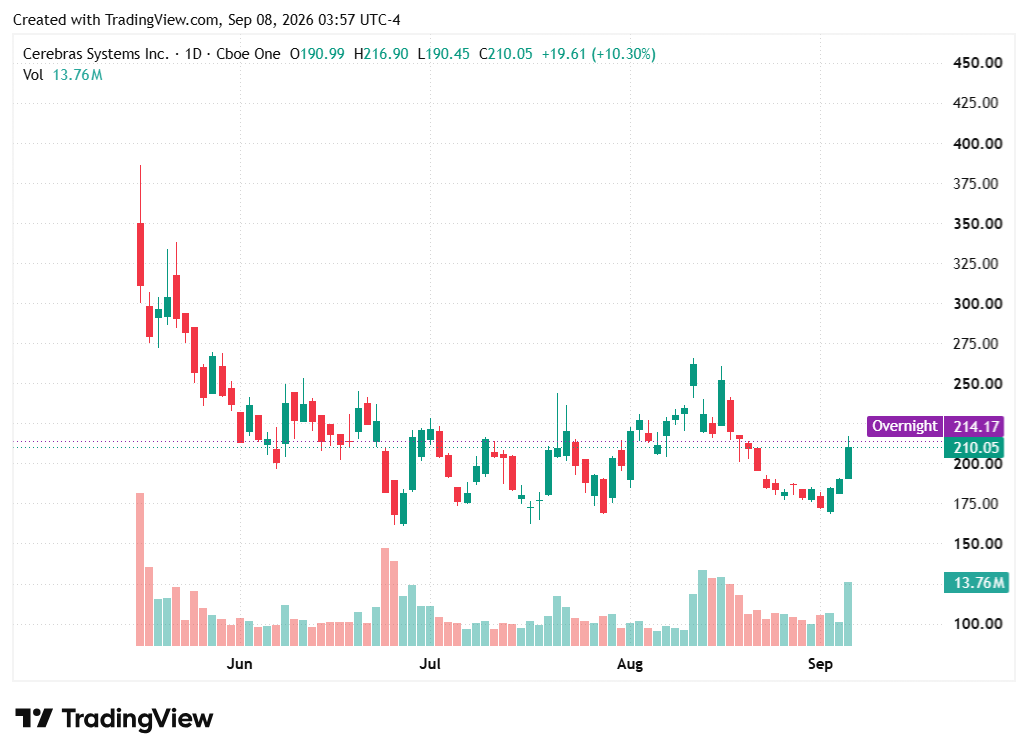
Cerebras broke one of chipmaking’s oldest rules, built the largest processor ever sold, and convinced OpenAI to commit more than $20 billion. The harder test begins now: delivering the capacity, defending the speed advantage, and keeping enough of the revenue after the data centers are paid for.
Position disclosure: At the time of writing, GB Capital holds a short-term swing position in CBRS. We do not hold CBRS in the long-term portfolio.
A finished silicon wafer looks too delicate to carry a business worth tens of billions of dollars. It is thin, reflective and patterned with circuits so small that the surface seems almost blank until light catches it. Every mainstream chipmaker takes that round wafer and cuts it into hundreds of separate chips.
Cerebras keeps a large square of it intact.
The result is the Wafer-Scale Engine, a processor large enough to be held in two hands and strange enough to violate the manufacturing logic that shaped the semiconductor industry for half a century. Its current WSE-3 family contains four trillion transistors, roughly 900,000 active AI cores and 44 gigabytes of SRAM distributed across 46,225 square millimeters of silicon. The new CS-4 puts three faster WSE-3 Turbo processors into one rack-scale system.
That scale makes for an excellent photograph. The investment case begins somewhere less visible: the distance data must travel.
Every time a large language model writes another token, the processor needs data from memory. Conventional systems have become extremely good at moving those numbers among GPUs, high-bandwidth memory, switches and racks. Cerebras spent a decade removing many of those journeys. It placed compute, memory and communication fabric across one continuous piece of silicon, then built an entire machine around it.
A QUICK NOTE BEFORE WE CONTINUE
We usually reserve Equity X-Rays like this one for paid subscribers.
This is the first time we are opening one in full.
We want you to see the work behind our research: the reading, the numbers, the competing evidence, and the hours spent testing a thesis before we publish it.
This article also marks the beginning of a much larger project for us.
Golden Bear Capital now brings together our newsletter, TradeDeck, one-to-one calls with our team, courses in swing trading and growth investing, and a free YouTube channel where we will tell company stories with the same depth, but through more visual and cinematic videos.
The site is not fully finished yet. We will add the remaining content and updates over the next few weeks, and we will keep you posted as each new part goes live.
We are putting everything we have into building it. If this research earns your trust, take a look at gb.capital. And if you know someone who would value it, sharing this article would mean a great deal to us.
OpenAI has now committed to purchase 750 megawatts of Cerebras inference capacity under a multi-year agreement that Cerebras values at more than $20 billion. The capacity is scheduled to arrive in stages through 2028. In August, OpenAI showed why it cares: GPT-5.6 Sol running in its limited Ultrafast preview generated up to 750 output tokens per second, as much as fourteen times the speed of standard processing, according to OpenAI. A week later, Cerebras introduced CS-4 and claimed another step forward in speed and throughput.
The contract validates demand. It does not settle the investment argument.
Cerebras must manufacture systems, secure power, fit out data centers, support changing models and meet delivery dates measured in hundreds of megawatts. NVIDIA remains the default platform for accelerated computing, backed by software, networking, engineers and infrastructure accumulated over many years. Specialized chips from AWS, Google, Groq and others keep improving. The company reported $180.1 million of GAAP revenue in the second quarter of 2026 and held $8.6 billion of liquidity, yet it also spent $548.9 million on property and equipment during the first half and produced a $450.5 million quarterly GAAP net loss, swollen by IPO-related stock compensation.
The thesis can be stated in one sentence:
“Cerebras can become a valuable specialist in high-speed AI inference if its advantage remains large enough to justify a second computing architecture, and if the company can deploy that architecture at scale without allowing capital intensity, customer concentration or falling prices to consume the economics.”
That sentence contains both the opportunity and the trap.
The distance tax inside AI
A large language model is a collection of learned numbers called weights. Training changes those weights. Inference uses them to answer a request. Cerebras sells systems for both jobs, but the OpenAI contract and the current public-market story are centered on inference.
The easiest way to understand inference is to split it into two stages.
During *prefill*, the system reads the prompt and its context. The words are converted into tokens, processed largely in parallel and represented in a working memory structure called the KV cache. A long legal document, a large codebase or a long conversation can make prefill heavy. Dense parallel computation and abundant memory capacity matter here.
During *decode*, the model generates the answer one token at a time. Each token depends on the sequence that came before it. That serial dependency means the hardware cannot produce token 500 before it has produced token 499. It repeatedly reads model data, performs the next calculation and emits the result.
Modern GPUs are extraordinary arithmetic machines. The problem is that decode can leave arithmetic capacity waiting for memory. The model weights may sit in high-bandwidth memory beside the GPU package, and large models may be divided across multiple GPUs. Data crosses package boundaries and interconnects. Each link is fast in isolation, but the repeated movement creates a tax.
Batching helps. A provider can serve many requests together and reuse the same weights across them, raising total throughput and lowering cost per token. That approach optimizes the data center. A person watching an agent write code cares about a different measure: how long one job takes from prompt to useful result. Maximum tokens across all users and maximum tokens for one user are different objectives.
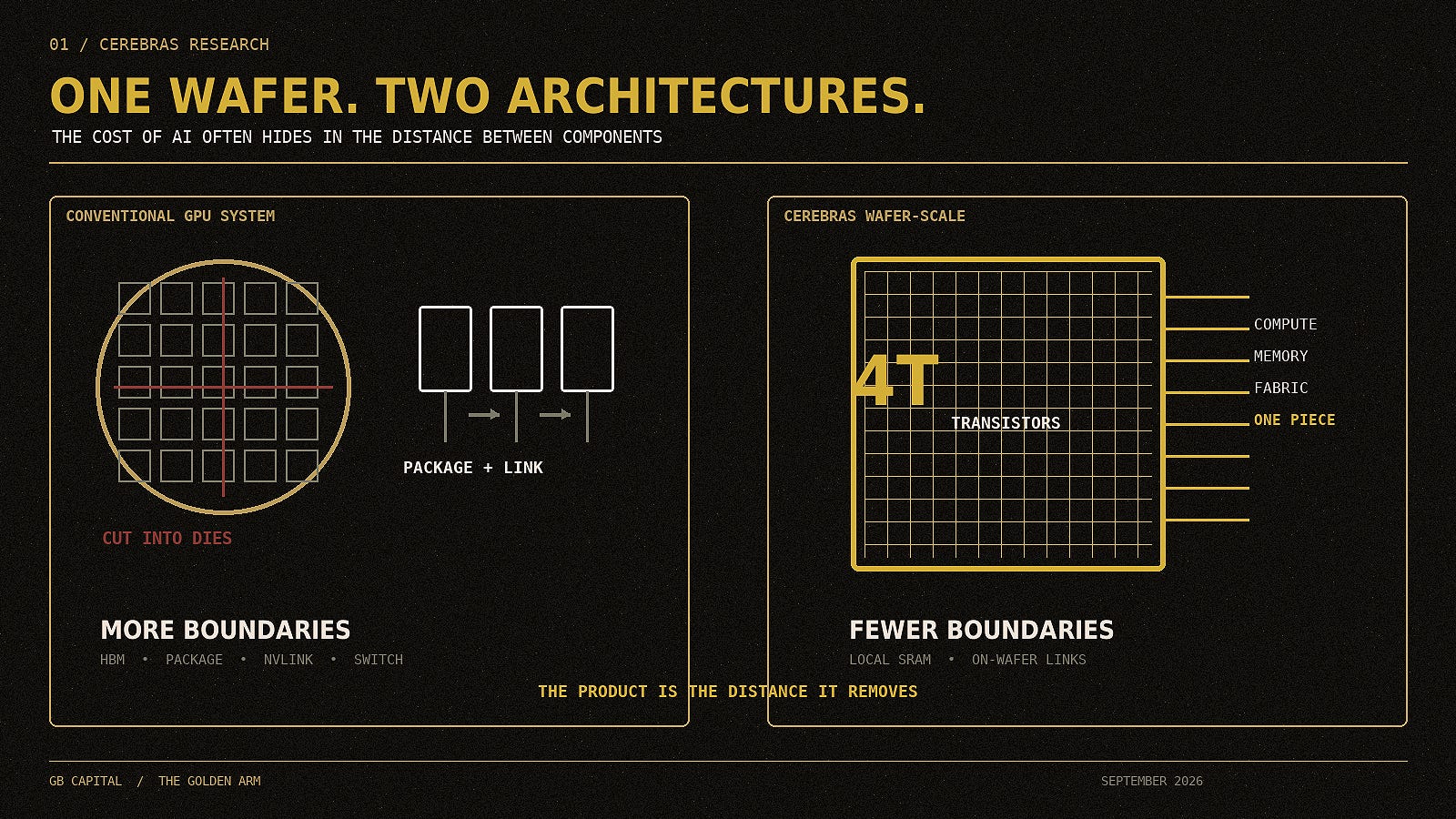
Cerebras attacks the distance tax with three linked design choices.
First, each small core has local SRAM. SRAM is fast because it avoids several operations required by denser memory technologies. Cerebras distributes that memory beside the computation instead of concentrating it in separate memory stacks. Across WSE-3, those small local pools add up to 44GB and, according to the company, 21.6 petabytes per second of aggregate memory bandwidth. WSE-3 Turbo doubles the per-wafer figure to 43.2 petabytes per second.
Second, the cores communicate through an on-wafer mesh. Data can move to neighboring cores without leaving the silicon, entering a package link, crossing a board and passing through a switch. Cerebras software maps operations and data across this physical grid.
Third, the architecture uses many small, independently programmable cores. Work starts when data arrives, and the system can skip some operations on zero values. The design suits workloads where locality, sparse computation and predictable movement matter.
An independent 2024 paper from researchers at the University of Southern California evaluated an earlier WSE generation and found that its 20 PB/s memory subsystem raised the boundary at which tested workloads became memory-limited. That evidence supports the architectural mechanism. It does not prove every marketing comparison made for later products. Benchmarks remain sensitive to the model, precision, batch size, input length, output length, quality settings, software version and hardware configuration. A tokens-per-second headline without those details is a trailer, not the film.

The manufacturing problem that killed earlier wafer-scale dreams
Making a processor enormous creates an immediate statistical problem.
Chip factories print repeated circuit patterns across a 300mm wafer. Dust, material imperfections and lithography errors create defects at random locations. If the wafer is divided into small dies, manufacturers test each die and discard the bad ones. A single defect ruins a small region rather than the whole wafer.
Increase the die area and the probability of encountering a defect rises. A conventional monolithic chip approaching wafer scale would have almost no chance of emerging perfectly intact. This is why earlier wafer-scale projects struggled and why the reticle limit, the maximum area exposed in one lithography step, became such a durable boundary.
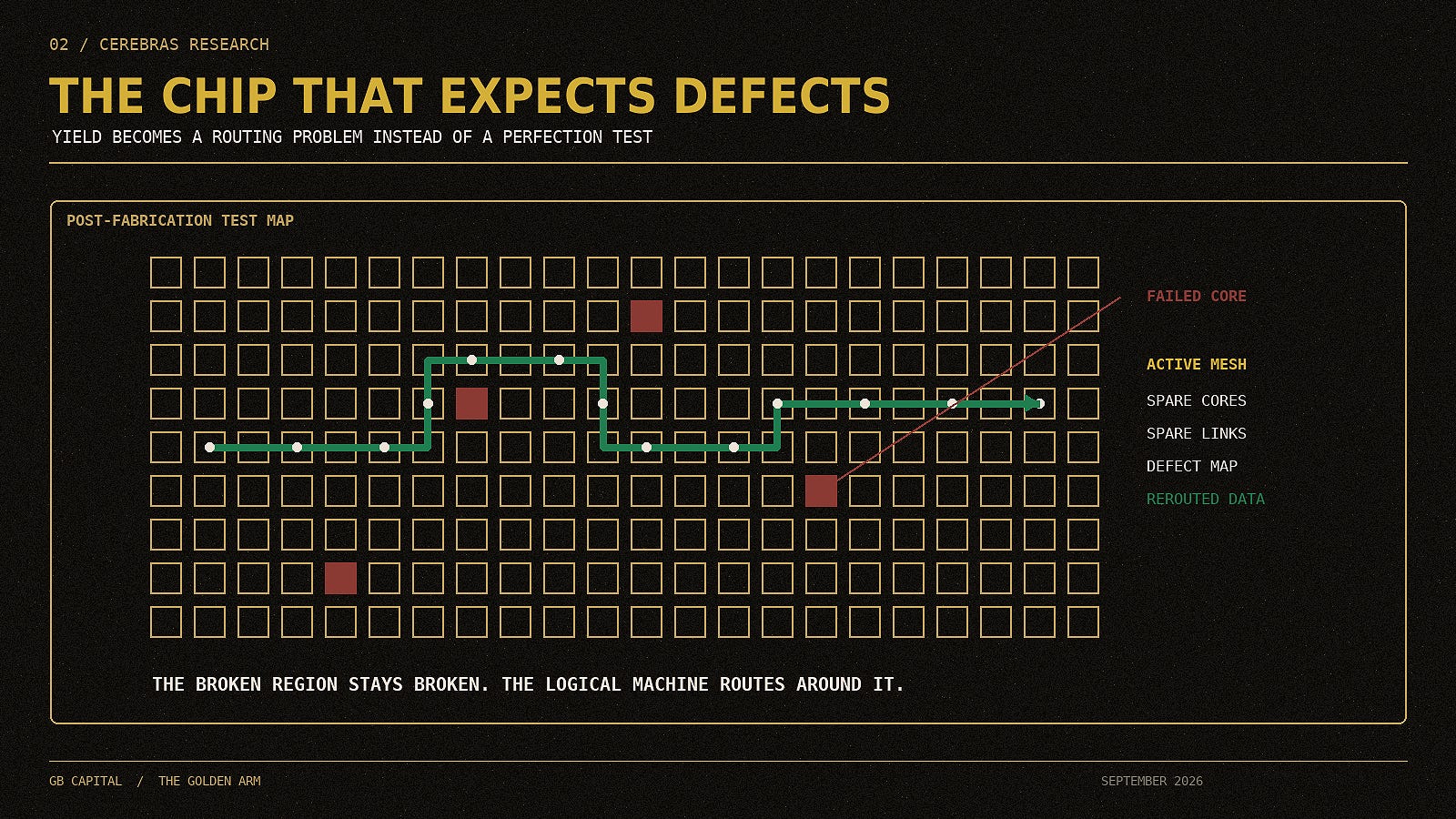
Cerebras did not eliminate defects. It reduced the amount of useful silicon each defect can destroy.
The WSE contains more physical cores and links than the product needs. After fabrication, Cerebras tests the wafer, maps failed regions, disables damaged components and configures the communication fabric to route around them. The company’s 2026 yield paper says WSE-3 contains roughly 970,000 total cores and activates about 900,000. A defect that lands inside a tiny core removes a very small fraction of the machine. Spare paths preserve a connected logical mesh.
This method is an extension of a familiar semiconductor practice. CPUs, GPUs and memory devices already ship with redundant units or disabled sections. Cerebras made fine-grained redundancy and fault-tolerant routing central to the product because a wafer-scale processor cannot depend on physical perfection.
Another problem sits at the border between lithography fields. Normal chips remain inside one exposure area. A wafer-scale processor spans many of them. Cerebras uses inter-die wiring to connect those regions across the lines where the wafer would ordinarily be cut. This allows the wafer to behave as a single logical processor.
Solving yield still leaves packaging, power delivery and cooling. The Computer History Museum’s description of the earlier CS-2 makes the point clearly: the wafer sits inside an “engine block” that supplies roughly 20 kilowatts, connects the surface to the outside world and carries heat away through water-cooled hardware. WSE-3 and CS-4 extend that systems work. In CS-4, Cerebras says moving power conversion from roughly 50 millimeters to about 0.5 millimeters from the processor reduces board-level loss and allows higher operating frequencies.
The wafer is the icon. The product is the machine surrounding it.
Fast memory has a price
SRAM gives Cerebras exceptional bandwidth, but it stores fewer bits per unit of silicon than DRAM or HBM. Filling a wafer with SRAM buys speed at the expense of memory density. The 44GB on WSE-3 is large for on-chip SRAM and small compared with the pooled HBM capacity available in a rack of GPUs.
That trade-off matters because frontier models are much larger than 44GB. Cerebras cannot place every weight of a multi-hundred-billion-parameter model into the SRAM of one wafer at once. It partitions the model across systems or uses external memory architecture and weight streaming, depending on the workload. Intermediate data still moves among machines. The trips are fewer or differently organized; they do not disappear.
This is also why direct core-count comparisons mislead. Nine hundred thousand Cerebras cores are not nine hundred thousand NVIDIA CUDA cores. Their instruction sets, data paths, memory relationships and intended work differ. Dividing one number by another produces a ratio with little operational meaning.
The honest comparison starts with a job. Fix the model, context length, output length, batch size, accuracy target and service level. Then measure time to first token, output tokens per second per user, aggregate throughput, cost, energy and failure rate. A provider optimizing a live coding assistant may accept a different frontier from one processing millions of cheap background summaries.
We built this platform to level up our own swing and momentum trading.
Get early access and unlock full subscriber features today.

Prefill and decode are becoming separate markets
The industry is beginning to place prefill and decode on different pools of hardware. This is called disaggregated inference.
The idea resembles a restaurant with separate preparation and service stations. Prefill reads and organizes the order. Decode plates each course in sequence. When both jobs share the same equipment, a large new prompt can interfere with ongoing token generation. Separating them lets each pool specialize and reduces contention.
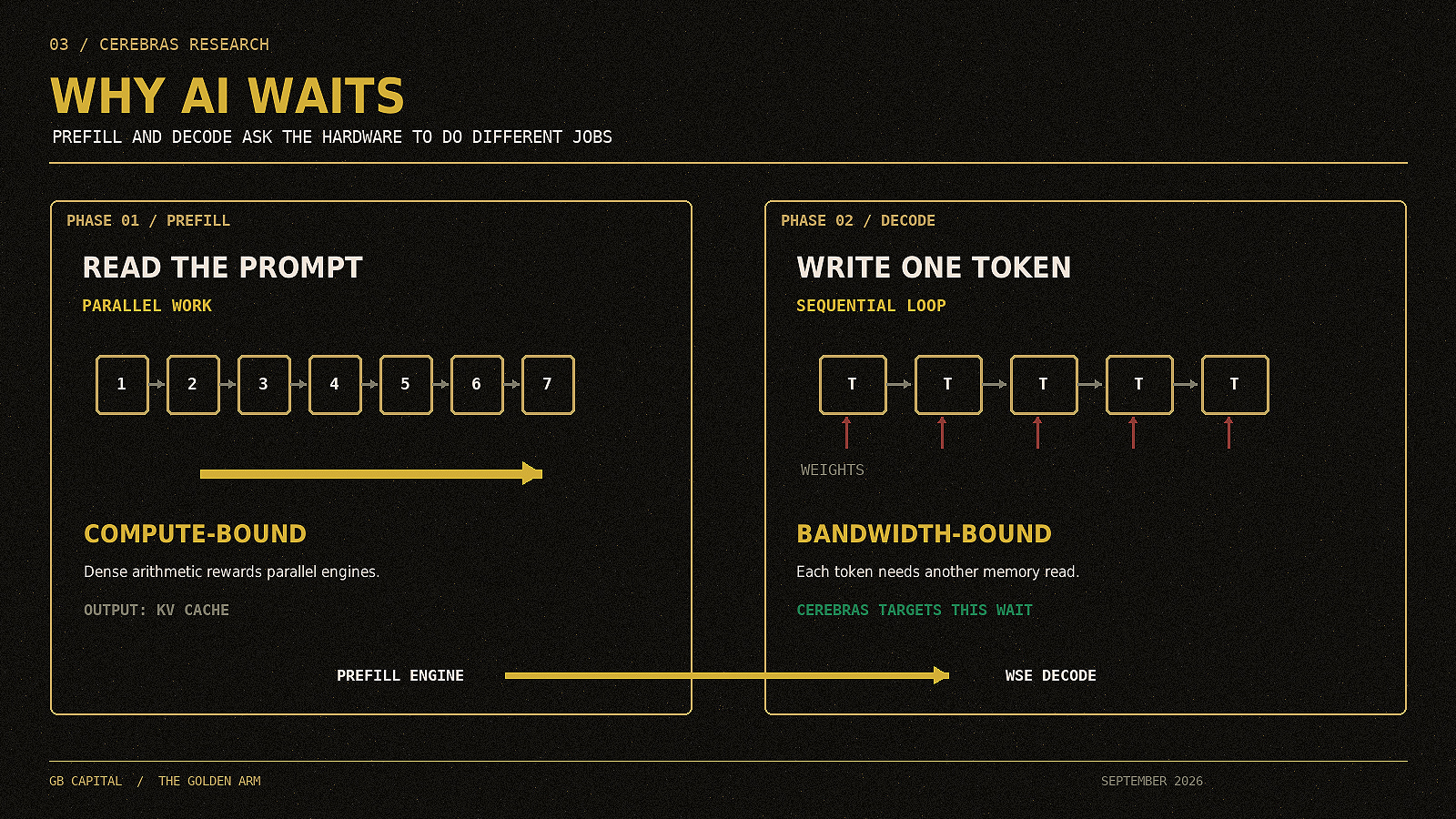
Cerebras has leaned into this split instead of claiming the wafer must replace every accelerator.
AWS plans to pair Trainium with Cerebras systems: Trainium handles compute-heavy prefill, while WSE handles bandwidth-heavy decode. The companies expect the joint design to deliver five times more high-speed token capacity in the same footprint, a forward-looking claim that still needs production evidence. The service is expected through Amazon Bedrock in the first quarter of 2027.
AMD and Cerebras announced a similar arrangement in July. AMD Helios rack-scale systems are intended to supply high-throughput prefill, while WSE supplies low-latency decode. Cerebras expects the first version through its cloud in the second half of 2026 and has said the combination could raise tokens per second per watt by as much as five times.
These partnerships reveal more than a benchmark table. They place Cerebras inside systems that use competing silicon. That reduces the burden of replacing a customer’s entire infrastructure. It also concedes that WSE has a narrower sweet spot than a general GPU platform.
Narrow can be an excellent business when the workload is large, expensive and painful enough.
Why speed becomes more valuable when AI starts doing work
A chatbot produces one answer. An agent produces a chain of actions.
Ask an AI coding agent to repair a broken button. It reads the repository, proposes a change, edits files, runs a test, studies the failure and tries again. Some of that time belongs to tools, networks and databases. Some belongs to the model generating tokens. Faster inference only shortens the model’s part of the chain.
That limitation keeps the analysis honest. A 10x faster model does not make a slow external API 10x faster. It cannot turn a wrong approach into a correct one. It can, however, create room for more attempts, more verification and a tighter conversation with the human before patience runs out.
Cognition offers a useful case. Its SWE-1.6 coding model runs at up to 950 tokens per second on a Cerebras-powered fast tier, according to the companies, and its SWE-grep tools use Cerebras for rapid codebase search. Cognition reported about a fivefold speed difference against its GPU-powered free tier. The important product decision was not to move every part of the agent onto WSE. It used fast inference where delay damaged the experience.
OpenAI provides a larger validation. On August 13, 2026, it previewed GPT-5.6 Sol Ultrafast on Cerebras at up to 750 output tokens per second. OpenAI described incident response and research as examples where shorter model waits allow teams to test more hypotheses while evidence is changing. The preview was limited, so adoption, pricing, utilization and quality at scale remain open questions.
The economic unit investors should watch is useful work completed per unit of time and cost. Tokens per second matters when it moves that outcome. If customers pay a premium, stay longer, run more work or achieve better results because of speed, Cerebras has pricing power. If they admire the demo and route routine workloads elsewhere, the advantage remains technical rather than economic.
From chip company to infrastructure operator
Cerebras began with hardware. Customers could buy CS systems for their own facilities, with support and software attached. Hardware revenue is recognized when control of the product transfers, so quarterly results can swing with a few large deliveries.
The cloud business changes the shape of the company. Cerebras owns or controls deployed systems, secures data-center capacity and sells access through dedicated reservations or on-demand consumption. Revenue can become more recurring, but Cerebras carries more of the infrastructure burden: leases, fit-out, power, utilization and operating risk.
The second quarter showed that transition in motion. Hardware revenue fell to $54.1 million from $70.3 million a year earlier. Cloud and other services revenue rose to $126.0 million from $33.0 million, an increase of 281%. Cloud represented roughly 70% of GAAP revenue for the quarter.
That mix shift is strategically attractive because recurring service revenue can compound as utilization grows. It is financially demanding because the machines and buildings arrive before all the service revenue. Capacity left idle burns cash. Capacity promised but delivered late can trigger penalties, shortened service periods or termination rights.
In September, Cerebras announced a 165MW data center in Mikkeli, Finland, under seven-year service orders with Compute Nordic Finland. Construction of the first 50MW phase was already under way. The site is part of a wider plan to reach 200MW of European capacity by the end of 2027. These announcements are evidence of contracted infrastructure, not proof that the capacity is energized, accepted by customers or producing target margins.
The company now faces two clocks. Semiconductor development moves in product generations. Data centers move through land, grid, construction, commissioning and service acceptance. Revenue arrives only when both clocks meet.
What OpenAI actually bought
The headline says “more than $20 billion.”
The contract says capacity delivered over time.
Under the Master Relationship Agreement signed in December 2025, Cerebras must make 250MW available by the end of 2026, another 250MW by the end of 2027 and a final 250MW by the end of 2028. Each tranche runs for three or four years and can be extended by OpenAI, subject to the disclosed terms. OpenAI is contractually committed to purchase the base 750MW as it is delivered. It also holds options for another 1.25GW by 2030, taking potential capacity to 2GW.
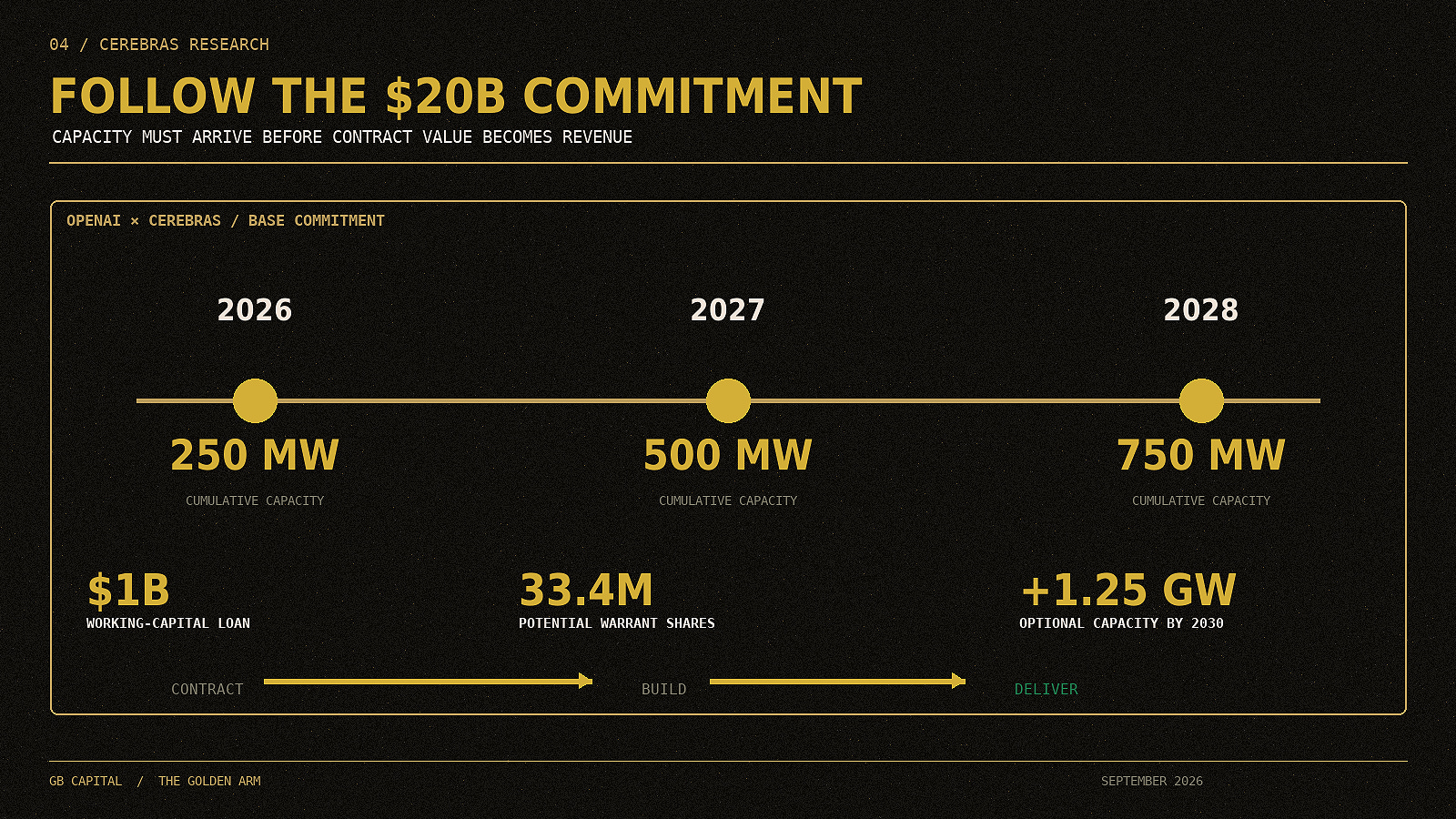
OpenAI advanced a secured working-capital loan of about $1 billion in January 2026. It carries a 6% interest rate, with interest potentially waived when repayment occurs through qualifying capacity, hardware, services or asset transfers. The loan matures no later than December 31, 2032. Certain failures under the agreement can give OpenAI greater control over the loan funds or accelerate repayment.
OpenAI also received a warrant to purchase up to 33,445,026 Class N shares at a nominal exercise price. The first tranche vested when Cerebras received the loan. Other portions depend on market-capitalization and capacity milestones. Full vesting requires OpenAI to exercise enough optional capacity to reach 2GW.
The relationship therefore connects four roles. OpenAI is a customer, lender, potential shareholder and technical collaborator. That alignment can help Cerebras finance and optimize its build. It can also shift negotiating power toward one customer and create dilution for existing shareholders.
Revenue recognition adds another layer. Cerebras recorded $56.8 million of revenue under the OpenAI arrangement during Q2, net of $2.5 million in warrant amortization. Some data-center costs are reimbursed and presented as pass-through revenue with minimal margin. A contract value, an RPO balance, reported revenue and cash received are four different numbers.
At June 30, Cerebras reported $25.4 billion in remaining performance obligations. About 22% is expected to be recognized in the first 24 months ending June 2028, 43% during months 25 through 48 and the rest later, though deployment timing can move. The RPO offers unusual visibility for a young hardware company. It also measures work still owed.
Reading the quarter without getting trapped by the adjustments
Cerebras reported two versions of its second quarter.
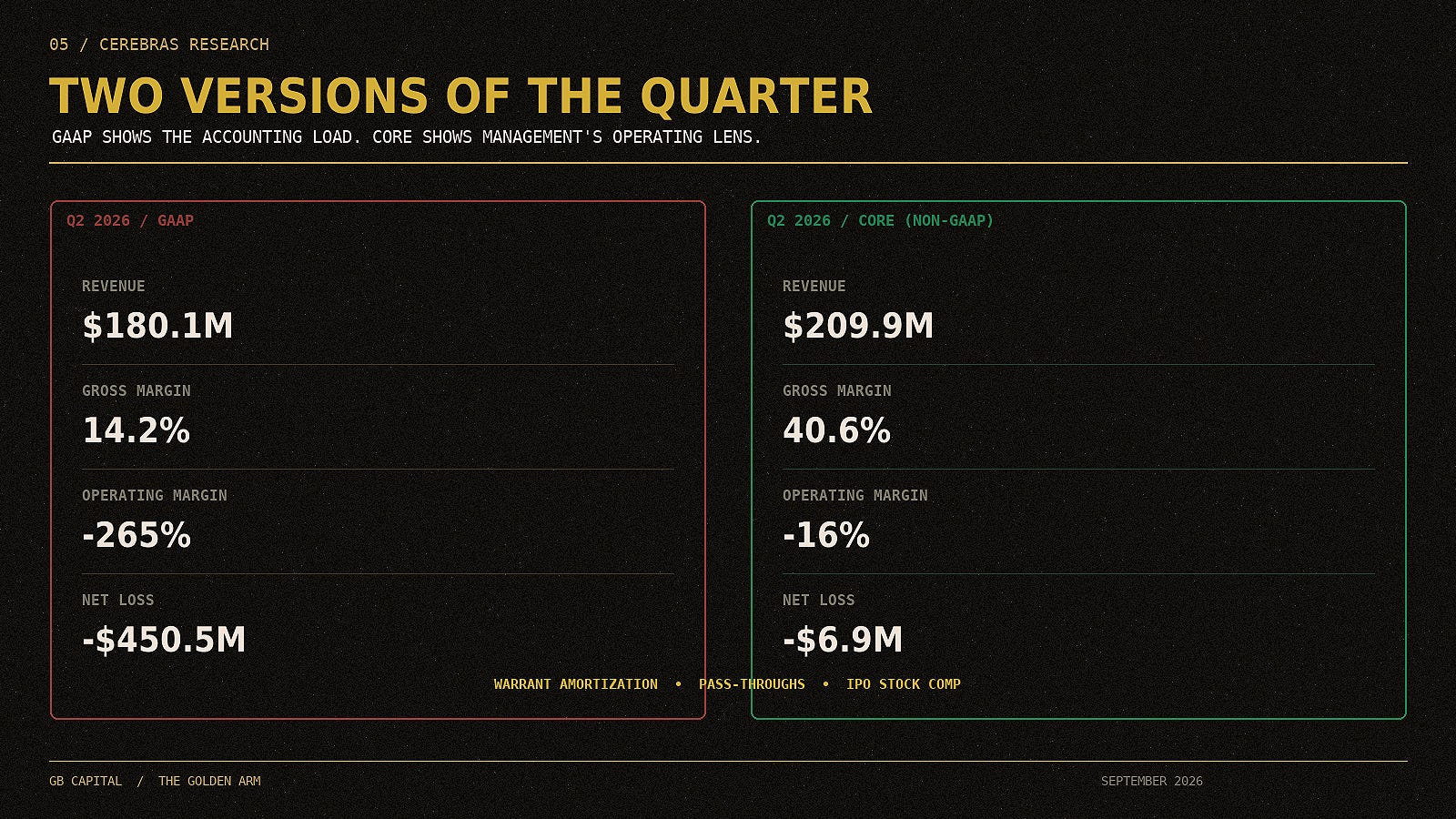
GAAP total revenue was $180.1 million, up 74% year over year. Management’s “core revenue” was $209.9 million, up 103%. GAAP gross margin was 14.2%; core gross margin was 40.6%. GAAP operating margin was negative 265%; core operating margin was negative 16%. GAAP net loss reached $450.5 million; core net loss was $6.9 million.
The gap needs to be understood rather than accepted or dismissed.
About $273.6 million of stock-based compensation was recognized in the quarter after the IPO satisfied the liquidity condition on older employee awards. That expense is non-cash in the period, yet it represents ownership transferred to employees and therefore matters to shareholders. Cerebras also recorded customer-warrant amortization as a reduction of revenue and incurred pass-through data-center costs that management argues obscure the economics of its technology and services.
Core results show that the operating business is much closer to break-even than the GAAP loss suggests. GAAP shows the cost of the equity and customer incentives used to build that business. An investor needs both views.
The balance sheet is unusually strong for a company at this stage. Cerebras completed its IPO in May at $185 per share, sold 34.5 million shares and received approximately $6.2 billion of net proceeds. Including cash, restricted cash and short-term investments, liquidity stood at $8.6 billion on June 30. An $850 million revolving credit facility added borrowing capacity.
The cash has a job. During the first six months of 2026, Cerebras spent $548.9 million on property and equipment, mainly systems for its cloud services. Operating activities used $47.5 million. Signed but not yet commenced data-center leases carried another $2.3 billion of undiscounted future minimum payments, beyond $690.3 million of existing lease commitments disclosed at quarter-end.
Management raised full-year 2026 core revenue guidance to $880–890 million, core gross margin to 41–43% and core operating margin to negative 19% to negative 17%. It also said it plans to more than triple revenue in 2027. Those numbers are guidance, not earned results.
One operational detail deserves attention. Cerebras rented back systems it had sold because demand outpaced its owned cloud capacity. That decision helped serve customers but pressured margin. Management expects core gross margin to trough at 38–40% in Q3 before improving as company-owned infrastructure comes online. This creates a clean test: if owned capacity replaces expensive rent-back supply and utilization remains strong, cloud margins should recover. If the recovery slips, the market will need to ask whether pricing, utilization or construction costs are weaker than expected.
Concentration is the accelerator and the risk
Two customers represented 66% of second-quarter revenue. MBZUAI alone represented 34%. OpenAI revenue under the MRA was $56.8 million, roughly another 32% of the total. G42 and MBZUAI are related parties, and the company expects OpenAI to represent a substantial share of projected revenue.
Large customers make an ambitious build possible. They provide commitments, financing, credibility and workloads large enough to justify specialized infrastructure. They can also reshape a supplier’s economics.
OpenAI has rights tied to delivery and service levels. AWS received a warrant for up to 2,696,678 Class N shares at $100 per share, with most vesting tied to payment thresholds. Its commercial agreement includes exclusivity, pricing commitments and minimum manufacturing-capacity protections. These terms help secure demand while limiting some freedom over supply and pricing.
Concentration should fall as new customers grow, but investors should demand evidence. Count announced logos cautiously. Measure revenue mix, deployed capacity and contract duration. One hyperscaler reducing an order can matter more than a dozen pilot customers arriving.
NVIDIA is a system, not a rectangle on a comparison slide
Cerebras is often framed as an NVIDIA killer because the picture is simple: one enormous wafer against a rack of GPUs. The market is less cinematic.
NVIDIA sells processors, networking, software libraries, inference runtimes, model tools, orchestration and enterprise support. CUDA, TensorRT, Triton, NIM, NeMo, GPU operators and the rest of the stack sit inside customer workflows. Engineers know them. Clouds sell them. Data centers are wired around them. A competitor must offer enough value to pay for integration, retraining, operational complexity and the risk of adding another vendor.
GPUs also serve a wider range of work. Heavy prefill, training, long contexts, multimodal models, scientific computing and workloads that change frequently can favor flexibility and large pools of HBM. NVIDIA improves both hardware and software at a fast cadence. It can attack decode through better memory, batching, speculative techniques, quantization and specialized components.
Cerebras does not need to replace NVIDIA across the data center. Its practical opening is to own a valuable stage of a larger system. The AWS and AMD partnerships make that strategy explicit. A customer can keep a familiar prefill platform and send decode to WSE when speed matters.
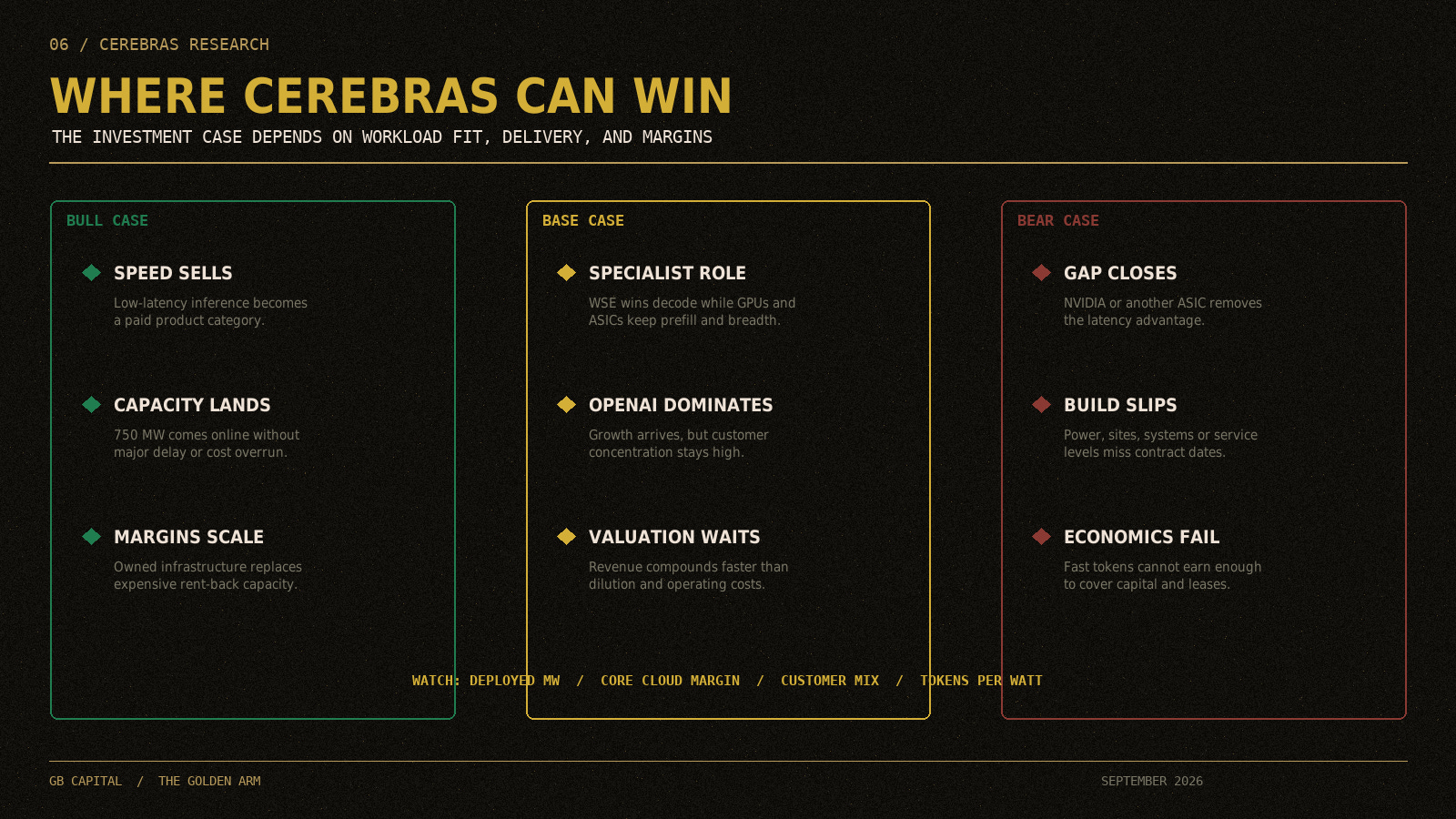
Other specialists add pressure. Google and AWS design their own accelerators. Groq built an SRAM-heavy inference architecture and licensed technology to NVIDIA. SambaNova and newer dataflow systems target adjacent problems. Model architecture can change faster than chip design. Techniques that reduce the number of generated tokens, compress weights or alter memory access can change the value of Cerebras’ strengths.
The moat must live in production: compiler quality, model support, uptime, deployment speed, total cost and sustained customer outcomes. Patents matter. A ten-year head start matters. Neither stops a customer from choosing a good-enough alternative already integrated into its stack.
The founder and the pattern behind the company
Andrew Feldman had already built one data-center hardware company before Cerebras. SeaMicro designed dense, energy-efficient microservers and a high-bandwidth fabric. AMD acquired it in 2012 for approximately $334 million. Feldman later founded Cerebras with Gary Lauterbach, Michael James, Sean Lie and Jean-Philippe Fricker.
The connection is visible. SeaMicro treated communication among many processors as a first-class design problem. Cerebras pushed the same instinct onto a wafer: computation matters, but the paths among computing units often decide the system’s performance.
The regulatory record also includes a fact that belongs in an investor profile. In 2007, Feldman pleaded guilty to circumventing internal accounting controls at Riverstone Networks, a previous employer, and received probation and a fine. The event occurred years before Cerebras and does not establish misconduct at the current company. It remains relevant when public shareholders evaluate governance and trust.
The current leadership’s challenge is less about proving technical audacity. WSE systems have shipped since 2020, reached customers and entered the Computer History Museum. The challenge is operating a capital-heavy public company whose largest contract can reward or punish execution at unprecedented scale.

Valuation: use milestones before decimals
Cerebras is difficult to value with a conventional earnings model.
It has negative GAAP earnings, negative free cash flow, a rapid shift from hardware to cloud services, customer-linked warrants and a backlog dominated by capacity that has not yet been delivered.
A price-to-sales multiple looks simple and can hide the central question. A dollar of low-margin pass-through revenue is not equal to a dollar of high-utilization cloud revenue. A dollar recognized from company-owned capacity may have different economics from a dollar served through rented-back systems. Growth without the margin bridge can destroy value even when the revenue chart looks spectacular.
We prefer a milestone framework.
1. Capacity delivered. Track live megawatts, customer acceptance and service levels against the 250MW annual OpenAI schedule. “Under contract” and “in production” belong in separate columns.
2. Core cloud margin. Management expects improvement after the Q3 trough as owned systems replace rented capacity. The direction and speed of that recovery will reveal more than one quarter of headline revenue.
3. Customer mix. OpenAI can remain the anchor while AWS, AMD-linked deployments, sovereign customers and enterprise workloads expand. A falling concentration ratio caused by new revenue would strengthen the business.
4. Capital efficiency. Compare incremental revenue and gross profit with property-and-equipment purchases, lease commitments and cash use. More revenue per deployed megawatt and more tokens per watt are useful only when they produce better returns on the capital required.
5. Product relevance. Watch supported frontier models, customer retention, independent benchmark quality and the share of workloads using disaggregated inference. CS-4 shipments beginning in Q3 2026 are an early test of the next product cycle.
6. Dilution. Track OpenAI and AWS warrant vesting, employee awards and the release of locked shares. Stock compensation can be non-cash and still reduce each existing shareholder’s claim on the business.
These milestones allow the valuation to update with evidence. A detailed 2030 price target built on assumed megawatts, utilization, pricing, margins and multiples can look precise while resting on five unstable variables.
What would change our mind
The thesis weakens if three things happen together: the per-user speed gap narrows materially on matched production workloads, core cloud gross margin fails to recover as owned capacity arrives, and customer concentration remains near current levels despite the wider partnership pipeline.
The thesis strengthens if Cerebras delivers the 2026 capacity commitment, converts CS-4 claims into independent production results, improves core cloud margin after Q3 and shows meaningful revenue from customers other than OpenAI, G42 and MBZUAI.
Near-term catalysts include CS-4 shipment evidence, deployment of the AMD disaggregated solution, progress toward AWS Bedrock availability in Q1 2027, the first European capacity entering service, Q3 margin results and any disclosure of delivered OpenAI megawatts.
The largest risk sits in a mundane sequence: site, power, equipment, cooling, network, software, customer acceptance. A wafer can work perfectly while the deployment around it misses a date.
The machine at the end of the wafer
The photograph of the processor still matters. It proves that a group of engineers took a manufacturing rule and treated it as a design variable. They accepted defects, mapped them and routed around them. They put memory beside compute and turned a wafer into one machine.
OpenAI’s commitment moves the story from architecture to industry. Cerebras must now repeat its engineering achievement across factories and data centers, then turn that capacity into revenue with margins that justify the capital.
The next proof will not fit in two hands. It will appear in deployed megawatts, customer mix, uptime, gross profit and cash flow.
This research is for informational purposes only and is not financial advice. Figures and forward-looking statements are based on information available as of September 2026. Company performance claims are identified as such and should be evaluated against matched, independent production benchmarks.